
Updated Jul-2025 Pass FCSS_EFW_AD-7.4 Exam - Real Practice Test Questions
Download Free Fortinet FCSS_EFW_AD-7.4 Real Exam Questions
NEW QUESTION # 22
Which statement about memory conserve mode is true?
- A. A FortiGate exits conserve mode when the configured memory use threshold reaches yellow.
- B. A FortiGate starts dropping new sessions when the configured memory use threshold reaches red
- C. A FortiGate Starts dropping all the new and old sessions when the configured memory use threshold reaches extreme.
- D. A FortiGate enters conserve mode when the configured memory use threshold reaches red
Answer: D
NEW QUESTION # 23
An administrator configured the following command on FortiGate.
config router ospf
set restart-mode graceful-restart
Which two statements correctly describe the result of the above command? (Choose two.)
- A. FortiGate is configured with graceful restart, and will exit graceful mode, if the network topology changes.
- B. In an HA cluster, FortiGate devices will keep the OSPF routes in their routing table to avoid traffic interruption during an HA failover.
- C. The OSPF neighbor that receives the grace link-state advertisement (LSA) will enter into helper mode.
- D. After the default 40 seconds wait time, the OSPF neighbors will resume communication with the restarting router.
Answer: B,C
NEW QUESTION # 24
Which two statements about application layer test commands are true? (Choose two.)
- A. Some of them can be used to restart an application.
- B. Some of them display statistics and configuration information about a feature or process.
- C. They are used to filter real-time debugs.
- D. They display real-time application debugs.
Answer: A,B
NEW QUESTION # 25
Which command is used to enable timestamp in a real-time debug?
- A. diagnose application timestamp enable
- B. diagnose debug console timestamp enable
- C. diagnose timestamp enable
- D. diagnose debug application timestamp enable
Answer: B
NEW QUESTION # 26
Refer to the exhibits, which show the configuration on FortiGate and partial session information for internet traffic from a user on the internal network.
If the priority on route ID 2 were changed from 10 to 0, what would happen to traffic matching that user session?
- A. The session would remain in the session table, but its traffic would now egress from both port1 and port2.
- B. The session would be deleted, and the client would need to start a new session.
- C. The session would remain in the session table, and its traffic would egress from port1.
- D. The session would remain in the session table, and its traffic would egress from port2.
Answer: C
NEW QUESTION # 27
Examine the following partial output from two system debug commands; then answer the question below.
Which of the following statements are true regarding the above outputs? (Choose two.)
- A. The unit is in kernel conserve mode
- B. Kernel indirectly accesses the low memory (Low Total) through memory paging
- C. The Cached value is always the Active value plus the Inactive value
- D. The unit is running a 32-bit FortiOS
Answer: C,D
NEW QUESTION # 28
Refer to the exhibit, which contains a TCL script configuration on FortiManager.
An administrator has configured the TCL script on FortiManager, but failed to apply any changes to the managed device after being executed.
Why did the TCL script fail to make any changes to the managed device?
- A. The TCL script must start with #include <>.
- B. Incomplete commands are ignored in TCL scripts.
- C. Changes in an interface configuration can only be done by CLI script.
- D. The TCL command run_cmd has not been created.
Answer: D
NEW QUESTION # 29
Refer to the exhibit, which contains the partial output of an IKE real-time debug.

The administrator does not have access to the remote gateway. Based on the debug output, which configuration change can the administrator make to the local gateway to resolve the phase 1 negotiation error?
- A. Change phase 1 encryption to AES128 and authentication to SHA512.
- B. Change phase 1 encryption to AESCBC and authentication to SHA128.
- C. Change phase 1 encryption to 3DES and authentication to SHA256.
- D. Change phase 1 encryption to 3DES and authentication to CBC.
Answer: C
NEW QUESTION # 30
Refer to the exhibit, which shows a physical topology and a traffic log.
The administrator is checking on FortiAnalyzer traffic from the device with IP address 10.1.10.1, located behind the FortiGate ISFW device.
The firewall policy in on the ISFW device does not have UTM enabled and the administrator is surprised to see a log with the action Malware, as shown in the exhibit.
What are the two reasons FortiAnalyzer would display this log? (Choose two.)
- A. ISFW is not connected to FortiAnalyzer and must go through NGFW-1.
- B. ISFW is in a Security Fabric environment.
- C. Security rating is enabled in ISFW.
- D. The firewall policy in NGFW-1 has UTM enabled.
Answer: B,D
Explanation:
From the exhibit, ISFW is part of a Security Fabric environment with NGFW-1 as the Fabric Root.
In this architecture, FortiGate devices share security intelligence, including logs and detected threats.
ISFW is in a Security Fabric environment:
Security Fabric allows devices like ISFW to receive threat intelligence from NGFW-1, even if UTM is not enabled locally.
If NGFW-1 detects malware from IP 10.1.10.1 to 89.238.73.97, this information can be propagated to ISFW and FortiAnalyzer.
The firewall policy in NGFW-1 has UTM enabled:
Even though ISFW does not have UTM enabled, NGFW-1 (which sits between ISFW and the external network) does have UTM enabled and is scanning traffic. Since NGFW-1 detects malware in the session, it logs the event, which is then sent to FortiAnalyzer.
NEW QUESTION # 31
One firewall policy in an enterprise firewall is essentially used for IPS.
Which configuration must the administrator check in this firewall policy to validate optimum performance for IPS?
- A. set cp-accel-mode enable
- B. set np-acceleration enable
- C. set inspection-mode proxy
- D. set offload enable
Answer: B
NEW QUESTION # 32
Refer to the exhibit.
A pre-run CLI template that is used in zero-touch provisioning (ZTP) and low-touch provisioning (LTP) with FortiManager is shown.
The template is not assigned even though the configuration has already been installed on FortiGate.
What is true about this scenario?
- A. The administrator must use post-run CLI templates that are designed for ZTP and LTP
- B. Pre-run CLI templates are automatically unassigned after their initial installation
- C. The administrator did not assign the template correctly when adding the model device because pre-CLI templates remain permanently assigned to the firewall
- D. Pre-run CLI templates for ZTP and LTP must be unassigned manually after the first installation to avoid conflicting error objects when importing a policy package
Answer: B
Explanation:
InFortiManager,pre-run CLI templatesare used inZero-Touch Provisioning (ZTP)andLow-Touch Provisioning (LTP)to configure a FortiGate devicebeforeit is fully managed by FortiManager.
These templatesapply configurationswhen a device is initially provisioned.Once the pre-run CLI template is executed, FortiManagerautomatically unassignsit from the device because it isnot meant to persistlike other policy configurations. This prevents conflicts and ensures that the FortiGate configuration isnot repeatedly appliedafter the initial setup.
NEW QUESTION # 33
Refer to the exhibit, which shows a partial routing table.
Assuming all the appropriate firewall policies are configured, what two changes would an administrator need to make if they wanted to send traffic from a client directly connected to port3, to a server directly connected to port4? (Choose two.)
- A. Configure route leaking between VRF 12 and VRF 21.
- B. Configure RIPv2 to exchange route information between the VRF instances.
- C. Disable auto-asic-offload as this is not supported between VRF instances.
- D. Configure route leaking between port3 and port4.
- E. Enable SNAT on the relevant firewall policies to prevent RPF check drops.
Answer: A,E
NEW QUESTION # 34
Which step can be taken to ensure that only FortiAP devices receive IP addresses from a DHCP server on FortiGate?
- A. Configure a VCI string value of FortiAP in the DHCP server settings
- B. Create a reservation list in the DHCP server settings
- C. Use DHCP option 138 to assign IPs to FortiAP devices
- D. Change the interface addressing mode to FortiAP devices
Answer: A
NEW QUESTION # 35
Which two statements about IKEv2 are true if an administrator decides to implement IKEv2 in the VPN topology? (Choose two.)
- A. It exchanges a minimum of two messages to establish a secure tunnel.
- B. It supports interoperability with devices using IKEv1.
- C. It supports the extensible authentication protocol (EAP).
- D. It includes stronger Diffie-Hellman (DH) groups, such as Elliptic Curve (ECP) groups.
Answer: C,D
Explanation:
IKEv2 (Internet Key Exchange version 2) is an improvement over IKEv1, offering enhanced security, efficiency, and flexibility in VPN configurations.
It includes stronger Diffie-Hellman (DH) groups, such as Elliptic Curve (ECP) groups. IKEv2 supports stronger cryptographic algorithms, including Elliptic Curve Diffie-Hellman (ECDH) groups such as ECP256 and ECP384, providing improved security compared to IKEv1.
It supports the extensible authentication protocol (EAP). IKEv2 natively supports EAP authentication, which allows integration with external authentication mechanisms such as RADIUS, certificates, and smart cards. This is particularly useful for remote access VPNs where user authentication must be flexible and secure.
NEW QUESTION # 36
View the following exhibit: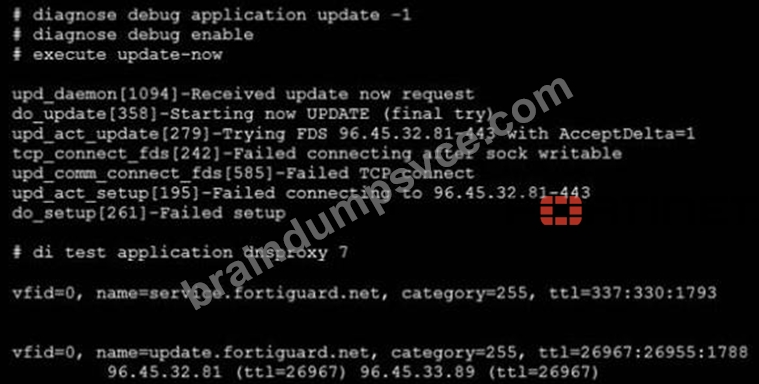
Given the output showing a real-time debug, which statement describes why the update is failing?
- A. FortiGate is unable to resolve the required FQDN (service.fortiguard.net) for AV and IPS updates.
- B. The administrator should use the execute update-wf command instead.
- C. FortiGate is unable to establish a TCP connection with FDS.
- D. The update should be using port 53 or port 8888, instead of port 443.
Answer: C
NEW QUESTION # 37
......
Fortinet FCSS_EFW_AD-7.4 Exam Syllabus Topics:
| Topic | Details |
|---|---|
| Topic 1 |
|
| Topic 2 |
|
| Topic 3 |
|
| Topic 4 |
|
| Topic 5 |
|
FCSS_EFW_AD-7.4 Dumps 100 Pass Guarantee With Latest Demo: https://www.braindumpsvce.com/FCSS_EFW_AD-7.4_exam-dumps-torrent.html
Pass Your Exam With 100% Verified FCSS_EFW_AD-7.4 Exam Questions: https://drive.google.com/open?id=1qRLlPEjYAKeZhcypl7kYAbaWbgMWkb6s