
CTAL-TM_Syll2012 Free Update With 100% Exam Passing Guarantee [2021]
[Sep-2021] Verified ISQI Exam Dumps with CTAL-TM_Syll2012 Exam Study Guide
NEW QUESTION 36
Testing Process
Consider an information system of a Pay-Tv company based on a SOA architecture.
The integrated system currently consists of three core systems:
- a CRM (Customer Relationship Management) system
- a BRM (Billing and Revenue Management) system
- a CAS (Conditional Access System) system
all of them communicating with SOA Middleware.
You have been asked to manage the testing activities for the integration of two additional off-the-shelf systems from two different vendors: a SMS (Short Message Service) server and an IVR (Interactive Voice Response) system.
Assume that there is a high likelihood that the two off-the-shelf systems will be low-quality and that you have a clear proof that the testing performed by the two vendors on their systems has been unsystematic and unprofessional. This obviously leads to higher quality risk for the overall integrated system.
You are the Test Manager of this project. Your main goal is to plan for testing activities to mitigate this risk.
Which of the following answers best describes the test activities (assuming it is possible to perform all of them) you should plan for?
Number of correct responses: 1
K4 3 credits
- A. You should plan for two levels: a system integration test and an end-to-end test of the overall integrated system
- B. You should plan for adequate re-testing of both the systems followed by a system integration test and an end-to-end test of the overall integrated system
- C. You should plan for an informal and minimal acceptance test of the two off-the-shelf systems and then a single end-to-end test of the overall integrated system
- D. You should directly plan for a single end-to-end test focused on end-to-end tests of the overall integrated system without an acceptance test of the two off-the-shelf systems
Answer: B
NEW QUESTION 37
Test Management
You are performing a quality risk analysis for a CSCI (Computer Software Configuration Item) used to implement a CBIT (Continuous Built-In Test) module of a safety-critical system.
During the quality risk analysis you are trying to identify the ways in which failures of the CBIT module can occur, for each of them trying to determine the potential causes and likely effects, and the risk level (calculated as the product of three factors: severity, occurrence and detection).
Which of the following risk analysis techniques are you working with?
- A. A lightweight product risk analysis technique
- B. Cost of Exposure
- C. Wide Band Delphi
- D. Failure Mode and Effect Analysis
Answer: D
NEW QUESTION 38
Assume you are currently working on a project developing a system where functional requirements are very well specified. Unfortunately non-functional requirements do almost not exist.
You are the Test Manager. You have to choose a technique for test selection that allows testing of non-functional characteristics, especially reliability.
Which of the following techniques for test selection do you expect being most useful in this scenario?
K2 1 credit
- A. Ambiguity reviews
- B. Cause-effect graphing
- C. A model-based technique based on the creation of operational profiles
- D. Test condition analysis
Answer: C
NEW QUESTION 39
Test Management
Which of the following statements about management of product quality risks in mature organizations with respect to the lifecycle, is true?
- A. Mature organizations are aware that risk management of product quality risks only occurs during testing
- B. Mature organizations are aware that the contribution of testing to analysis of product quality risks is very important. The analysis should occur throughout the entire lifecycle
- C. Mature organizations address product quality risks associated to non-functional characteristics only during the system test phase
- D. Mature organizations don't waste time identifying the sources of risks. They only focus on identifying product quality risks
Answer: B
Explanation:
Section: Test Management
NEW QUESTION 40
You are the Test Manager of a new project aimed at developing a software system that must be certified at level B of the DO-178B standard. The project will follow a V-Model software development life cycle and it will have four formal levels of testing: component, integration, system and acceptance testing.
You must produce the test plan documentation for this project by providing an adequate coordination across the four levels of testing in order to assure audit ability.
Which of the following answers would you expect to best describe how to organize the test plan?
K3 2 credits
- A. Produce a master test plan that covers three levels (component, integration, system test) and a separate acceptance test plan
- B. Produce a single master test plan that covers in detail all four levels, describing the particular activities for all test levels
- C. Produce a master test plan describing the relationship between the four levels, and four separate detailed level test plans, one for each level
- D. Produce four separate detailed level test plans, one for each level, without a master test plan
Answer: C
NEW QUESTION 41
People Skills - Team Composition
An agile development team decides to hire a tester who has always worked:
- in independent test teams, reporting the problems found in a defect tracking system
- in safety-critical projects, with a stronger focus on the quality of the product than on time and budget.
This agile team is focused on short-term goals to get the product released on time and within budget.
Which of the following answers would you expect to be most likely true in this scenario?
Number of correct responses: 1
K2 1 credit
- A. The tester can continue to report the problems found in a defect tracking system and be more focused on the quality than on time and budget constraints
- B. The tester's mission could be to verify adherence to requirements, instead of reporting formally the problems in a defect tracking system
- C. Agile teams like the presence of a tester in their teams and the tester will be able to adapt to the new context without any issue
- D. The developers will immediately follow the guidelines described by the tester
Answer: B
NEW QUESTION 42
Test Management
You are working on a project to develop an authentication system for an e-commerce website. This system provides two features: Registration and authentication. Two different development teams develop these two features.
There is a high likelihood that the delivery of the authentication feature to the test team will be three weeks later. To complete the registration the user must provide the following registration inputs: Name, surname, birthdate, fiscal code and he/she can select a username and a password.
A registered user can be a special user or a normal user. To be identified as a special user, he/she must also provide, during the registration process, a voucher possibly received from the IT department.
Access is granted only if a user is registered and the password is correct: In all other cases access is denied. If the registered user is a special user and the password is wrong, a special warning is shown on the system console.
You are currently performing a quality risk analysis using FMEA.
Based only on the given information, which of the following is NOT a product risk that could be identified during the quality risk analysis?
- A. The late delivery of the authentication feature to the test team causes delays in the start of test execution and this could result in a shorter test period
- B. The authentication system grants access to a special user with a wrong password
- C. The authentication system denies access for a special user with a wrong password, but doesn't display a special warning on the system console
- D. The authentication system grants access to a normal user with a wrong password
Answer: A
Explanation:
Section: Test Management
NEW QUESTION 43
You can count on well-written requirements, but you can't count on an adequate contribution of the stakeholders to the quality risk analysis. You have to mitigate the insufficient contribution of the stakeholders because the risk-based testing approach shall minimize the product risks. Your test team has one expert tester in security testing.
Which of the following test activities would you expect to be the less important in this context?
- A. Automate all functional and non-functional system tests
- B. Extract from the defect tracking system of the previous project all the security defects and failures, and classify them to support design and execution of specific tests
- C. Apply systematic and exploratory testing for integration and system test
- D. Perform exploratory testing sessions with adequate charters covering security aspects
Answer: A
Explanation:
Section: Test Management
NEW QUESTION 44
Consider the following statements describing the importance of improving the test process:
I. Test process improvement is important because being focused only on the test process it can provide recommendations to improve the test process itself, but it can't indicate or suggest improvement to areas of the development process
II. Test process improvement is important because it is much more effective than software process improvement to improve the quality of a software system
III. Test process improvement is important because several process improvement models (STEP, TPI Next, TMMi) have been developed over the years
IV. Test process improvement is important because every organization, regardless of the context, should always achieve the maximum level of maturity of testing described in the test improvement models such as TMMi
Which of the following answers is correct?
K2 1 credit
- A. I. and IV. are true; II. and III. are false
- B. I., II. and III. are false; IV. is true
- C. I., II., III. and IV are false
- D. I., II. and III are true; IV. is false
Answer: C
NEW QUESTION 45
During the follow-up phase the following conditions are checked:
X1. The code has been completely reviewed
X2. All the identified defects have been correctly fixed and the modified code has been compiled successfully and run through all the static analyzers used by the project without warnings and errors X3. The modified code is available under the configuration management system with a new version number for the specified CI If these conditions are fulfilled then the review process terminates.
Which of the following characteristics of a formal review is missing in this description?
Number of correct responses: 1
K2 1 credit
- A. Deliverables such as reports, evaluation sheets or other review summary sheets
- B. Checklists to be used by the reviewers
- C. Metrics for reporting on the review effectiveness, efficiency, and progress
- D. Defined entry and exit criteria
Answer: C
NEW QUESTION 46
Testing Process
The following are the exit criteria described in the test plan of a software product:
EX1. The test suite for the product must ensure that at least each quality risk item is covered by at least one test case (a quality risk item can be covered by more test cases).
EX2. All test cases in the test suite must be run during the execution phase.
EX3. Defects are classified into two categories: "C" (critical defect) and "NC" (non-critical defect). No known C defects shall exist in the product at the end of the test execution phase.
Which of the following information is useless when the specified exit criteria is evaluated?
Number of correct responses: 1
K2 1 credit
- A. A list of all the open defects with the associated classification information extracted from the defect tracking system
- B. A traceability matrix showing the relationships between the product risk items and the test cases
- C. A chart, showing the trend in the lag time from defect reporting to resolution, extracted from the defect tracking system
- D. The execution status of all the test cases extracted from the test management tool
Answer: C
NEW QUESTION 47
Which of the following statements, about the test reporting activities for a project adopting an iterative lifecycle model with very short iterations (e.g. two weeks iterations), is correct?
K2 1 credit
- A. Test reporting activities can't be influenced by the use of an iterative lifecycle model with short iterations
- B. Test reporting activities are not important for projects adopting an iterative lifecycle model with short iterations
- C. Test reporting activities are still important with an iterative lifecycle. The reports can be used to conduct post-iteration review sessions before starting with the next iteration
- D. Test reporting activities are less important for projects adopting an iterative life cycle model with short iterations. They should be performed at the end of the last iteration
Answer: C
NEW QUESTION 48
Test Management
Based on the historical data of 5 past and similar projects, you have calculated these average numbers of defects detected in system testing:
- for each 10000 LOC (lines of code), 200 defects
- for each person-month of development team effort, 49 defects
You want to use this information to perform estimation for a new project.
The project manager tells you that he/she has estimated 20000 new LOC for this new project.
Four developers work for four months on this project before system testing.
During system testing, 797 defects are discovered.
Assume that the system test of this new project is using the same amount of work as spent in the past projects.
Based on this information only, which of the following statement is certainly true about this project?
- A. 40000 LOC have been delivered to system testing (against the 20000 LOC planned by the project manager)
- B. More LOC than planned have been delivered to system testing with a higher defect density than the past projects
- C. The number of defects found during the system test phase on the new project is approximately proportional to the development team effort
- D. The code for the new project contains a higher defect density than the code of the past projects
Answer: C
Explanation:
Section: Test Management
NEW QUESTION 49
You are managing the system testing for a SOA based system. The integrated system consists of several subsystems:
-
A SOA middleware
-
A CRM (Customer Relationship Management) system
-
A BRM (Billing and Revenue Management) system
-
A SMS (Subscriber Management System) system and you performed a risk analysis based on these subsystems.
At the end of the scheduled period for test execution you produce a first classical report based on the traditional metrics of testing. Test pass/fail status and bug status (open/resolved) That table provides you a distorted picture of the quality risk, because there is no indication of the risk level of the failed tests, the tests not run, or the open bugs. Thus, you produce the following table to solve this distortion issue:
In the table above, where you have introduced the concept of risk weighting, the highest risk test or bug report has a score of 1, while the lowest risk test or bug report has a score of 0.04.
Which of the following subsystems, based on the risk scores of the table, is most risky?
K4 3 credits
- A. BRM
- B. CRM
- C. SMS
- D. SOA
Answer: B
NEW QUESTION 50
Which of the following statements represents the most effective contribution of the stakeholders to the completion of the failure mode analysis table?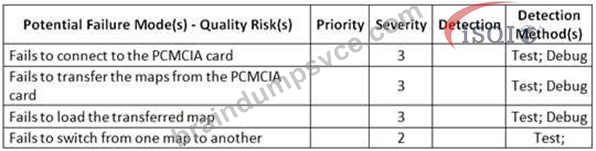
- A. The system architect and the chief software engineer should contribute to assess the priority. The expert tester is the only one who should contribute to assess the detection.
- B. The aircraft pilot and the customer representative should contribute to assess the priority. The chief software engineer, the system architect and the expert tester should contribute to assess the detection.
- C. The aircraft pilot is the only one qualified to contribute to assess the priority and thus should be assigned this task. The customer representative should contribute to assess the detection.
- D. The aircraft pilot and the customer representative should contribute to assess the detection. The chief software engineer, the system architect and the expert tester should contribute to assess the priority.
Answer: B
Explanation:
Section: Test Management
NEW QUESTION 51
Improving the Testing Process
Which of the following statements about the TMMi test process improvement model is true?
- A. In TMMi all the process areas at lower levels must be 75% complete by achieving specific and generic goals in order to claim the higher level
- B. At TMMi level 1 testing is chaotic without a defined process, and it is often seen as the same as debugging
- C. TMMi provides an approach for test process improvement such as the IDEAL (Initiating, Diagnosing, Establishing, Acting and Learning) model
- D. TMMi has a staged architecture for process improvement with seven maturity levels
Answer: B
NEW QUESTION 52
Reviews
You are a Test Manager working for a software organization where reviews have never been applied. After a meeting with your managers examining a business case for reviews, (including their costs, benefits, and potential issues), the management finally decides to adopt formal reviews for future projects.
You have been given a budget that you have spent to provide training in the review process and to introduce the review process on a pilot project.
On that pilot project the introduction of reviews has been very positive in terms of positive involvement from all the participants. All the reviews applied to different documents have been very effective for their purposes (especially at revealing defects).
Which of the following answers describes an important success factor for the introduction of formal reviews which is missing in this scenario?
Number of correct responses: 1
K4 3 credits
- A. Definition and use of metrics to measure the ROI (Return On Investment)
- B. Management support
- C. Training in the review process
- D. Participant support
Answer: A
NEW QUESTION 53
Assume you have some data related to confirmation testing during system testing of a past project.
In that project 240 bug reports have been opened once, 80 were opened twice, 10 were opened three times and no bug reports have been opened more than three times.
You estimate that a bug report, which has failed its confirmation test, costs, on average, 3 person-hours.
Which of the following statements correctly describe the value of these confirmatory testing activities based on cost of quality?
K3 2 credits
- A. 300 person-hours have been spent on the project during the system testing phase, because of the failed confirmation tests and this cost belongs to the costs of internal failure
- B. 340 person-hours have been spent on the project during the system testing phase, because of the failed confirmation tests and this cost belongs to the costs of internal failure
- C. 340 person-hours have been spent on the project during the system testing phase, because of the failed confirmation tests and this cost belongs to the costs of external failure
- D. 300 person-hours have been spent on the project during the system testing phase, because of the failed confirmation tests and this cost belongs to the costs of detection
Answer: A
NEW QUESTION 54
The following is the unique "critical" quality risk item that has been identified:
CR-RSK-1. The GUI of the application might accept non-integer values for the input field designed to get the number of bottles from the user Test analysis for system testing has just begun and the following test conditions have been identified:
TC-SEL-2. Test the selection of the package sizes
TC-SEL-4. Test wrong numbers of bottles for an order
TC-CR-RSK-1. Test the accepted values from the input field designed to get the number of bottles from the user What is the MINIMUM number of test conditions that must be added to fulfill both the EXCR1 and EXCR2 exit criteria?
Number of correct responses: 1
K3 2 credits
- A. 0
- B. 1
- C. 2
- D. 3
Answer: C
NEW QUESTION 55
Testing Process
Which of the following is an example of the test closure activity indicated as "lessons learned"?
Number of correct responses: 1
K2 1 credit
- A. Participate in a meeting at the end of a project aimed at better managing the events and problems of future projects
- B. Deliver a list of the open defects of a software product released into production to the service desk team
- C. Archive all the test results of the acceptance testing phase
- D. Deliver an automated regression test suite, used during the system test phase of a software product released into production, to the team responsible for maintenance testing
Answer: A
NEW QUESTION 56
You are the Test Manager for a project to develop a web customer portal of a Pay-TV company that allows customers (with a smartcard and a set-top box) to purchase digital contents.
In the "select" page the system displays a dialogue where the customer can select the items (digital contents) he/she is interested in. In this page he/she can add one or more items to a shopping cart. An item consists of a product and a duration.
There are three types of products: Movie, sport and premium (movie and sport).
There are four possible durations: 1 months, 2 months, winter (from the beginning of January to end of March) and summer (from the beginning of July to end of September).
All the combinations of products and durations are allowed to define an item. Thus there are twelve possible items. A maximum of six different items can be added to the shopping cart at a time.
When the customer decides to check out he/she goes to the "purchase" page where he/she can pay the total amount of the shopping cart in three different ways:
-
using a credit voucher
-
using a credit already charged on the smartcard
-
using a credit card (accepted credit cards are. Visa, MasterCard and Great Wall Card)
The customer can logout from both the "select" and "purchase" pages. In this case no purchase is made.
You decide to apply a blended risk-based and reactive testing strategy and the following is a subset of the exit criteria for system testing: EXCR1- Each "critical" quality risk item must be covered by at least one test condition EXCR2- Each "critical" requirement must be covered by at least one test condition
You are following a risk-based testing strategy. The test execution time is very limited. Assume that all the product risk items require more or less the same level of test effort.
Which of the following answers describes the best execution schedule in this scenario?
K3 3 credits
- A. 1- Test the correct pre-activation of the Smart Card 2- Test the correct charge of the Smart Card with the required contents 3- Test the correct activation of the Smart Card 4- Test the acceptance of transactions coming from the IVR channel
- B. 1- Test the acceptance of transactions coming from the IVR channel 2- Test the correct charge of the Smart Card with the required contents 3- Test the correct pre-activation of the Smart Card 4- Test the correct activation of the Smart Card
- C. 1- Test the correct activation of the Smart Card 2- Test the correct pre-activation of the Smart Card 3- Test the correct charge of the Smart Card with the required contents 4- Test the acceptance of transactions coming from the IVR channel
- D. 1- Test the correct pre-activation of the Smart Card 2- Test the correct activation of the Smart Card 3- Test the correct charge of the Smart Card with the required contents 4- Test the acceptance of transactions coming from the IVR channel
Answer: D
NEW QUESTION 57
You are the Test Manager of a project that adopts a V-model with four formal levels of testinG. unit, integration, system and acceptance testing.
On this project reviews have been conducted for each development phase prior to testing, which is to say that reviews of requirements, functional specification, high-level design, low-level design and code have been performed prior to testing.
Assume that no requirements defects have been reported after the release of the product.
Which TWO of the following metrics do you need in order to evaluate the requirements reviews in terms of phase containment effectiveness?
K3 2 credits
- A. Time to conduct the requirements review
- B. Total number of defects found during functional specification review, high-level design review, low-level design review, code review, unit testing, integration testing, system testing and acceptance testing
- C. Number of defects found during the requirements review
- D. Total number of defects attributable to requirements, found during functional specification review, high-level design review, low-level design review, code review, unit testing, integration testing, system testing and acceptance testing
- E. Total number of defects attributable to requirements found during unit, integration, system and acceptance testing
Answer: C,D
Explanation:
Topic 4, Defect Management
NEW QUESTION 58
......
Authentic Best resources for CTAL-TM_Syll2012 Online Practice Exam: https://www.braindumpsvce.com/CTAL-TM_Syll2012_exam-dumps-torrent.html