
Current MS-102 Exam Dumps [2026] Complete Microsoft Exam Smoothly
MS-102 Premium PDF & Test Engine Files with 588 Questions & Answers
Microsoft MS-102 Exam Syllabus Topics:
| Topic | Details |
|---|---|
| Topic 1 |
|
| Topic 2 |
|
| Topic 3 |
|
| Topic 4 |
|
NEW QUESTION # 325
You have a Microsoft 365 subscription that contains three groups named All users, Sales team, and Office users, and two users shown in the following table.
In Microsoft Endpoint Manager, you have the Policies for Office apps settings shown in the following exhibit.
The policies use the settings shown in the following table.
What is the default share folder location for User1 and the default Office theme for User2? To answer, select the appropriate options in the answer area.
NOTE: Each correct selection is worth one point.
Answer:
Explanation:
Explanation:
Reference:
https://docs.microsoft.com/en-us/deployoffice/overview-office-cloud-policy-service
NEW QUESTION # 326
You need to configure automatic enrollment in Intune. The solution must meet the technical requirements.
What should you configure, and to which group should you assign the configurations? To answer, select the appropriate options in the answer area.
NOTE: Each correct selection is worth one point.
Answer:
Explanation:
Explanation:
Reference:
https://docs.microsoft.com/en-us/mem/intune/enrollment/windows-enroll
NEW QUESTION # 327
DRAG DROP
Your network contains an on-premises Active Directory domain that syncs to Azure Active Directory (Azure AD). The domain contains the servers shown in the following table.
You use Azure Information Protection.
You need to ensure that you can apply Azure Information Protection labels to the file stores on Server1.
Which three actions should you perform in sequence? To answer, move the appropriate actions from the list of actions to the answer area and arrange them in the correct order.
Answer:
Explanation:
Explanation:
Reference:
https://docs.microsoft.com/en-us/azure/information-protection/install-configure-rms-connector
https://docs.microsoft.com/en-us/azure/information-protection/configure-servers-rms-connector
NEW QUESTION # 328
You need to meet the technical requirement for log analysis.
What is the minimum number of data sources and log collectors you should create from Microsoft Cloud App Security? To answer, select the appropriate options in the answer area.
NOTE: Each correct selection is worth one point.
Answer:
Explanation:
Explanation
References:
https://docs.microsoft.com/en-us/cloud-app-security/discovery-docker
Topic 3, Litware Inc.
Case Study
This is a case study. Case studies are not timed separately. You can use as much exam time as you would like to complete each case. However, there may be additional case studies and sections on this exam. You must manage your time to ensure that you are able to complete all questions included on this exam in the time provided.
To answer the questions included in a case study, you will need to reference information that is provided in the case study. Case studies might contain exhibits and other resources that provide more information about the scenario that is described in the case study. Each question is independent of the other questions in this case study.
At the end of this case study, a review screen will appear. This screen allows you to review your answers and to make changes before you move to the next section of the exam. After you begin a new section, you cannot return to this section.
To start the case study
To display the first question in this case study, click the Next button. Use the buttons in the left pane to explore the content of the case study before you answer the questions. Clicking these buttons displays information such as business requirements, existing environment, and problem statements. If the case study has an All Information tab, note that the information displayed is identical to the information displayed on the subsequent tabs. When you are ready to answer a question, click the Question button to return to the question.
Overview
General Overviews
Litware, Inc. is a technology research company. The company has a main office in Montreal and a branch office in Seattle.
Environment
Existing Environment
The network contains an on-premises Active Directory domain named litware.com. The domain contains the users shown in the following table.
Microsoft Cloud Environment
Litware has a Microsoft 365 subscription that contains a verified domain named litware.com. The subscription syncs to the on-premises domain.
Litware uses Microsoft Intune for device management and has the enrolled devices shown in the following table.
Litware.com contains the security groups shown in the following table.
Litware uses Microsoft SharePoint Online and Microsoft Teams for collaboration.
The verified domain is linked to an Azure Active Directory (Azure AD) tenant named litware.com. Audit log search is turned on for the litware.com tenant.
Problem Statements
Litware identifies the following issues:
* Users open email attachments that contain malicious content.
* Devices without an assigned compliance policy show a status of Compliant.
* User1 reports that the Sensitivity option in Microsoft Office for the web fails to appear.
* Internal product codes and confidential supplier ID numbers are often shared during Microsoft Teams meetings and chat sessions that include guest users and external users.
Requirements
Planned Changes
Litware plans to implement the following changes:
* Implement device configuration profiles that will configure the endpoint protection template settings for supported devices.
* Configure information governance for Microsoft OneDrive, SharePoint Online, and Microsoft Teams.
* Implement data loss prevention (DLP) policies to protect confidential information.
* Grant User2 permissions to review the audit logs of he litware.com tenant.
* Deploy new devices to the Seattle office as shown in the following table.
* Implement a notification system for when DLP policies are triggered.
* Configure a Safe Attachments policy for the litware.com tenant.
Technical Requirements
Litware identifies the following technical requirements:
* Retention settings must be applied automatically to all the data stored in SharePoint Online sites, OneDrive accounts, and Microsoft Teams channel messages, and the data must be retained for five years.
* Emails messages that contain attachments must be delivered immediately, and placeholder must be provided for the attachments until scanning is complete.
* All the Windows 10 devices in the Seattle office must be enrolled in Intune automatically when the devices are joined to or registered with Azure AD.
* Devices without an assigned compliance policy must show a status of Not Compliant in the Microsoft Endpoint Manager admin center.
A notification must appear in the Microsoft 365 compliance center when a DLP policy is triggered.
User2 must be granted the permissions to review audit logs for the following activities:
- Admin activities in Microsoft Exchange Online
- Admin activities in SharePoint Online
- Admin activities in Azure AD
Users must be able to apply sensitivity labels to documents by using Office for the web.
Windows Autopilot must be used for device provisioning, whenever possible.
A DLP policy must be created to meet the following requirements:
- Confidential information must not be shared in Microsoft Teams chat sessions, meetings, or channel messages.
- Messages that contain internal product codes or supplier ID numbers must be blocked and deleted.
The principle of least privilege must be used.
NEW QUESTION # 329
You have a Microsoft 365 subscription that contains the devices shown in the following table.
You install Microsoft Word on all the devices.
You plan to configure policies to meet the following requirements:
* Word files created by using Windows devices must be encrypted automatically.
* If an Android device becomes jailbroken, access to corporate data must be blocked from Word.
* For iOS devices, users must be prevented from using native or third-party mail clients to connect to Microsoft 365.
Which type of polio/ should you configure for each device? To answer, drag the appropriate policy types to the correct devices. Each policy type may be used once, more than once, or not at all. You may need to drag the split bar between panes or scroll to view content.
NOTE: Each correct selection is worth one point.
Answer:
Explanation:
Explanation
NEW QUESTION # 330
HOTSPOT
You have a Microsoft 365 E5 subscription that contains a Microsoft SharePoint Online site named Site1 and the users shown in the following table.
The devices are configured as shown in the following table.
You have a Conditional Access policy named CAPolicy1 that has the following settings:
1.Assignments
Users or workload identities: Group1
Cloud apps or actions: Office 365 SharePoint Online
Conditions
- Filter for devices: Exclude filtered devices from the policy
- Rule syntax: device.displayName -startsWith "Device"
2.Access controls
Grant
- Grant: Block access
Session: 0 controls selected
3.Enable policy: On
For each of the following statements, select Yes if the statement is true. Otherwise, select No.
NOTE: Each correct selection is worth one point.
Answer:
Explanation:
Explanation: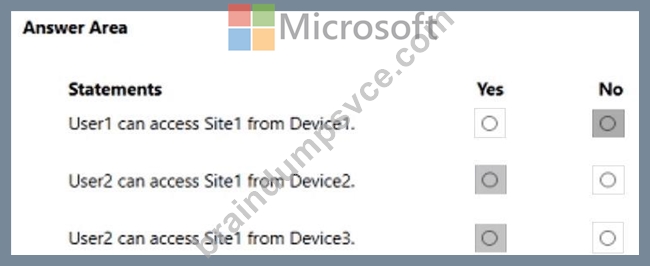
Box 1: No
User1 is member of Group1 and has Device1.
Device1 is not Azure AD joined.
Note: Requiring a hybrid Azure AD joined device is dependent on your devices already being hybrid Azure AD joined.
Box 2: Yes
User2 is member of Group1 and has devices Device2 and Device3.
Device2 is Azure AD joined.
Device2 is excluded from CAPolicy1 (which would block access to Site1).
Box 3: Yes
User2 is member of Group1 and has devices Device2 and Device3.
Device3 is Android and is Azure AD registered.
Device3 is excluded from CAPolicy1 (which would block access to Site1).
Note: On Windows 7, iOS, Android, macOS, and some third-party web browsers, Azure AD identifies the device using a client certificate that is provisioned when the device is registered with Azure AD. When a user first signs in through the browser the user is prompted to select the certificate. The end user must select this certificate before they can continue to use the browser.
Reference:
https://learn.microsoft.com/en-us/azure/active-directory/devices/howto-hybrid-azure-ad-join
https://learn.microsoft.com/en-us/azure/active-directory/conditional-access/howto-conditional-access-policy- compliant-device
NEW QUESTION # 331
You have an Microsoft Entra tenant.
You have 1,000 computers that run Windows 10 Pro and are joined to Microsoft Entra ID.
You purchase a Microsoft 365 E3 subscription.
You need to deploy Windows 10 Enterprise to the computers. The solution must minimize administrative effort.
What should you do?
- A. From the Microsoft Endpoinf Manager admin center, create a Windows Autopilot deployment profile.
Assign the profile to all the computers. Instruct users to restart their computer and perform a network restart. - B. From Windows Configuration Designer, create a provisioning package that has an EditionUpgrade configuration and upload the package to a Microsoft SharePoint Online site. Instruct users to run the provisioning package from SharePoint Online.
- C. Enroll the computers in Microsoft Intune. Create a configuration profile by using the Edition upgrade and mode switch template. From the Microsoft Endpoint Manager admin center, assign the profile to all the computers and instruct users to restart their computer.
- D. From the Microsoft Entra ID admin center, create a security group that has dynamic device membership. Assign licenses to the group and instruct users to sign in to their computer.
Answer: C
NEW QUESTION # 332
Your network contains an on-premises Active Directory domain. The domain contains 2,000 computers that run Windows 10.
You purchase a Microsoft 365 subscription.
You implement password hash synchronization and Azure AD Seamless Single Sign-On (Seamless SSO).
You need to ensure that users can use Seamless SSO from the Windows 10 computers.
What should you do?
- A. Deploy an Azure AD Connect staging server.
- B. Modify the Intranet zone settings by using Group Policy.
- C. Join the computers to Azure AD.
- D. Create a conditional access policy in Azure AD.
Answer: C
NEW QUESTION # 333
You have a Microsoft 365 tenant that contains a Windows 10 device named Device1 and the Microsoft Endpoint Manager policies shown in the following table.
The policies are assigned to Device1.
Which policy settings will be applied to Device1?
- A. only the settings of Policy3
- B. no settings
- C. only the settings of Policy2
- D. only the settings of Policy1
Answer: B
NEW QUESTION # 334
HOTSPOT
You have a Microsoft 365 E5 subscription that contains a user named User1.
Microsoft Entra ID Password Protection is configured as shown in the following exhibit.
User1 attempts to update their password to the following passwords:
F@lcon
Project22
T4il$pin45dg4
Use the drop-down menus to select the answer choice that completes each statement based on the information presented in the graphic.
NOTE: Each correct selection is worth one point.
Answer:
Explanation:
Explanation:
Box 1: Only T4il$pin45dg4
Box 2: can attempt to sign in immediately
Note: Manage Microsoft Entra ID smart lockout values
Based on your organizational requirements, you can customize the Microsoft Entra ID smart lockout values.
Customization of the smart lockout settings, with values specific to your organization, requires Microsoft Entra ID Premium P1 or higher licenses for your users. Customization of the smart lockout settings is not available for Azure China 21Vianet tenants.
To check or modify the smart lockout values for your organization, complete the following steps:
Sign in to the Entra portal.
Search for and select Microsoft Entra ID, then select Security > Authentication methods > Password protection.
Set the Lockout threshold, based on how many failed sign-ins are allowed on an account before its first lockout.
The default is 10 for Azure Public tenants and 3 for Azure US Government tenants.
Set the Lockout duration in seconds, to the length in seconds of each lockout.
The default is 60 seconds (one minute).
If the first sign-in after a lockout period has expired also fails, the account locks out again. If an account locks repeatedly, the lockout duration increases.
Reference:
https://learn.microsoft.com/en-us/azure/active-directory/authentication/howto-password-smart-lockout
NEW QUESTION # 335
HOTSPOT
You have a Microsoft 365 E5 subscription that contains the users shown in the following table.
You add the following assignment for the User Administrator role:
Scope type: Directory
Selected members: Group1
Assignment type: Active
Assignment starts: Mar 15, 2023
Assignment ends: Aug 15, 2023
You add the following assignment for the Exchange Administrator role:
Scope type: Directory
Selected members: Group2
Assignment type: Eligible
Assignment starts: Jun 15, 2023
Assignment ends: Oct 15, 2023
For each of the following statements, select Yes if the statement is true. Otherwise, select No.
NOTE: Each correct selection is worth one point.
Answer:
Explanation:
Explanation
Box 1: Yes
Admin1 is member of Group1.
The User Administrator role assignment has Group1 as a member.
The assignment type: Active
July 15, 2023 is with the assignment period.
A User Administrator can manage all aspects of users and groups, including resetting passwords for limited admins.
Box 2: No
Admin2 is member of Group2.
The Exchange Administrator role assignment has Group2 as a member.
The assignment type: Eligible
June 20, 2023 is with the assignment period.
The assignment must be approved.
Note: Eligible assignment requires member or owner to perform an activation to use the role. Activations may also require providing a multi-factor authentication (MFA), providing a business justification, or requesting approval from designated approvers.
Box 3: Yes
Admin3 is member of Gropu1 and Group2.
The User Administrator role assignment has Group1 as a member.
The assignment type: Active
May 1, 2023 is with the assignment period.
Reference:
https://learn.microsoft.com/en-us/azure/active-directory/roles/permissions-reference
https://learn.microsoft.com/en-us/azure/active-directory/privileged-identity-management/groups-assign-member-
NEW QUESTION # 336
You have a Microsoft 365 tenant that has Enable Security defaults set to No in Microsoft Entra ID (Microsoft Entra ID).
The tenant has two Compliance Manager assessments as shown in the following table.
The SP800 assessment has the improvement actions shown in the following table.
You perform the following actions:
For the Data Protection Baseline assessment, change the Test status of Establish a threat intelligence program to Implemented.
Enable multi-factor authentication (MFA) for all users.
For each of the following statements, select Yes if the statement is true. Otherwise, select No.
NOTE: Each correct selection is worth one point.
Answer:
Explanation:
Explanation:
Reference:
https://docs.microsoft.com/en-us/microsoft-365/compliance/compliance-manager-assessments?view=o365-worldwide#create-assessments
https://docs.microsoft.com/en-us/microsoft-365/compliance/compliance-score-calculation?view=o365-worldwide#action-types-and-points
NEW QUESTION # 337
You need to meet the technical requirement for large-volume document retrieval. What should you create?
- A. an alert policy from the Security & Compliance admin center
- B. an activity policy from Microsoft Cloud App Security
- C. a data loss prevention (DLP) policy from the Security & Compliance admin center
- D. a file policy from Microsoft Cloud App Security
Answer: B
Explanation:
References:
https://docs.microsoft.com/en-us/office365/securitycompliance/activity-policies-and-alerts
Topic 3, Litware Inc.
Case Study
This is a case study. Case studies are not timed separately. You can use as much exam time as you would like to complete each case. However, there may be additional case studies and sections on this exam. You must manage your time to ensure that you are able to complete all questions included on this exam in the time provided.
To answer the questions included in a case study, you will need to reference information that is provided in the case study. Case studies might contain exhibits and other resources that provide more information about the scenario that is described in the case study. Each question is independent of the other questions in this case study.
At the end of this case study, a review screen will appear. This screen allows you to review your answers and to make changes before you move to the next section of the exam. After you begin a new section, you cannot return to this section.
To start the case study
To display the first question in this case study, click the Next button. Use the buttons in the left pane to explore the content of the case study before you answer the questions. Clicking these buttons displays information such as business requirements, existing environment, and problem statements. If the case study has an All Information tab, note that the information displayed is identical to the information displayed on the subsequent tabs. When you are ready to answer a question, click the Question button to return to the question.
Overview
General Overviews
Litware, Inc. is a technology research company. The company has a main office in Montreal and a branch office in Seattle.
Environment
Existing Environment
The network contains an on-premises Active Directory domain named litware.com. The domain contains the users shown in the following table.
Microsoft Cloud Environment
Litware has a Microsoft 365 subscription that contains a verified domain named litware.com. The subscription syncs to the on-premises domain.
Litware uses Microsoft Intune for device management and has the enrolled devices shown in the following table.
Litware.com contains the security groups shown in the following table.
Litware uses Microsoft SharePoint Online and Microsoft Teams for collaboration.
The verified domain is linked to an Azure Active Directory (Azure AD) tenant named litware.com. Audit log search is turned on for the litware.com tenant.
Problem Statements
Litware identifies the following issues:
* Users open email attachments that contain malicious content.
* Devices without an assigned compliance policy show a status of Compliant.
* User1 reports that the Sensitivity option in Microsoft Office for the web fails to appear.
* Internal product codes and confidential supplier ID numbers are often shared during Microsoft Teams meetings and chat sessions that include guest users and external users.
Requirements
Planned Changes
Litware plans to implement the following changes:
* Implement device configuration profiles that will configure the endpoint protection template settings for supported devices.
* Configure information governance for Microsoft OneDrive, SharePoint Online, and Microsoft Teams.
* Implement data loss prevention (DLP) policies to protect confidential information.
* Grant User2 permissions to review the audit logs of he litware.com tenant.
* Deploy new devices to the Seattle office as shown in the following table.
* Implement a notification system for when DLP policies are triggered.
* Configure a Safe Attachments policy for the litware.com tenant.
Technical Requirements
Litware identifies the following technical requirements:
* Retention settings must be applied automatically to all the data stored in SharePoint Online sites, OneDrive accounts, and Microsoft Teams channel messages, and the data must be retained for five years.
* Emails messages that contain attachments must be delivered immediately, and placeholder must be provided for the attachments until scanning is complete.
* All the Windows 10 devices in the Seattle office must be enrolled in Intune automatically when the devices are joined to or registered with Azure AD.
* Devices without an assigned compliance policy must show a status of Not Compliant in the Microsoft Endpoint Manager admin center.
A notification must appear in the Microsoft 365 compliance center when a DLP policy is triggered.
User2 must be granted the permissions to review audit logs for the following activities:
- Admin activities in Microsoft Exchange Online
- Admin activities in SharePoint Online
- Admin activities in Azure AD
Users must be able to apply sensitivity labels to documents by using Office for the web.
Windows Autopilot must be used for device provisioning, whenever possible.
A DLP policy must be created to meet the following requirements:
- Confidential information must not be shared in Microsoft Teams chat sessions, meetings, or channel messages.
- Messages that contain internal product codes or supplier ID numbers must be blocked and deleted.
The principle of least privilege must be used.
NEW QUESTION # 338
Note: This question is part of a series of questions that present the same scenario. Each question in the series contains a unique solution that might meet the stated goals. Some question sets might have more than one correct solution, while others might not have a correct solution.
After you answer a question in this section, you will NOT be able to return to it. As a result, these questions will not appear in the review screen.
Your network contains an on-premises Active Directory domain named contoso.com. The domain contains the users shown in the following table.
The domain syncs to an Azure AD tenant named contoso.com as shown in the exhibit. (Click the Exhibit tab.)
User2 fails to authenticate to Azure AD when signing in as [email protected].
You need to ensure that User2 can access the resources in Azure AD.
Solution: From the Microsoft Entra admin center, you assign User2 the Security Reader role. You instruct User2 to sign in as [email protected].
Does this meet the goal?
- A. No
- B. Yes
Answer: A
Explanation:
Explanation
This is not a permissions issue so you do not need to assign the Security Reader role.
The on-premises Active Directory domain is named contoso.com. User2 could sign on as [email protected] but you would first need to change the UPN of User2 to [email protected].
NEW QUESTION # 339
You have a Microsoft 365 E5 subscription that contains the users shown in the following table.
Each user has a device with the Microsoft Authenticator app installed.
From Microsoft Authenticator settings for the subscription, the Enable and Target settings are configured as shown in the exhibit. (Click the Exhibit tab.)
For each of the following statements, select Yes if the statement is true. Otherwise, select No.
NOTE: Each correct selection is worth one point.
Answer:
Explanation:
Explanation:
NEW QUESTION # 340
You have a Microsoft 365 E5 subscription that contains a Microsoft SharePoint site named Sitel. Site!
contains the files shown in the following table.
You have a data loss prevention (DLP) policy named DLP1 that has the advanced DLP rules shown in the following table.
You apply DLP1 to Site1.
Which policy tip is displayed for each file? To answer, select the appropriate options in the answer area.
NOTE: Each correct selection is worth one point.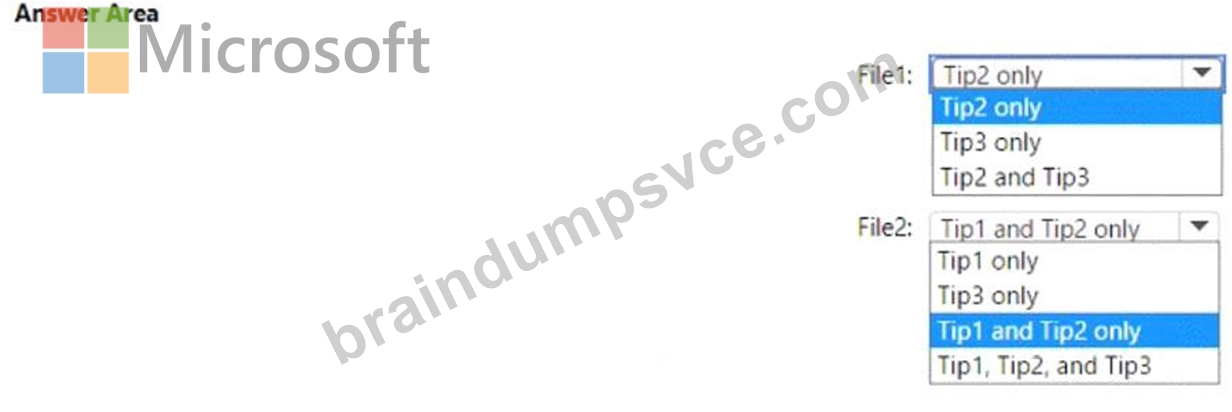
Answer:
Explanation:
Explanation:
NEW QUESTION # 341
You have a Microsoft 365 E5 subscription that uses Microsoft Defender for Cloud Apps.
You need to create a policy that will generate an email alert when a banned app is detected requesting permission to access user information or data in the subscription.
What should you configure? To answer, select the appropriate options in the answer area.
NOTE: Each correct selection is worth one point.
Answer:
Explanation:
Explanation:
NEW QUESTION # 342
HOTSPOT
Your network contains an Active Directory domain named fabrikam.com. The domain contains the objects shown in the following table.
The groups have the members shown in the following table.
You are configuring synchronization between fabrikam.com and an Azure AD tenant.
You configure the Domain/OU Filtering settings in Azure AD Connect as shown in the Domain/OU Filtering exhibit (Click the Domain/OU Filtering tab.)
You configure the Filtering settings in Azure AD Connect as shown in the Filtering exhibit. (Click the Filtering tab.)
For each of the following statements, select Yes if the statement is true. Otherwise, select No.
NOTE: Each correct selection is worth one point.
Answer:
Explanation:
Explanation:
Box 1: No
The filtering is configured to synchronize Group2 and OU2 only. The effect of this is that only members of Group2 who are in OU2 will be synchronized.
User2 is in Group2. However, the User2 account object is in OU1 so User2 will not synchronize to Azure AD.
Box 2: Yes
Group2 is in OU2 so Group2 will synchronize to Azure AD. However, only members of the group who are in OU2 will synchronize. Members of Group2 who are in OU1 will not synchronize.
Box 3: Yes
User3 is in Group2 and in OU2. Therefore, User3 will synchronize to Azure AD.
Reference:
https://docs.microsoft.com/en-us/azure/active-directory/hybrid/how-to-connect-sync-configure- filtering#group-based-filterin
NEW QUESTION # 343
You have a Microsoft 365 tenant that contains 100 Windows 10 devices. The devices are managed by using Microsoft Endpoint Manager.
You plan to create two attack surface reduction (ASR) policies named ASR1 and ASR2. ASR1 will be used to configure Microsoft Defender Application Guard. ASR2 will be used to configure Microsoft Defender SmartScreen.
Which ASR profile type should you use for each policy? To answer, select the appropriate options in the answer area.
NOTE: Each correct selection is worth one point.
Answer:
Explanation:
Explanation
Graphical user interface, text, application, chat or text message Description automatically generated
Reference:
https://docs.microsoft.com/en-us/mem/intune/protect/endpoint-security-asr-policy
NEW QUESTION # 344
You have a hybrid deployment of Microsoft Entra that contains the users shown in the following table.
You need to identify which users can perform the following tasks:
* View sync errors in Microsoft Entra Connect Health.
* Configure Microsoft Entra Connect Health settings.
Which user should you identify for each task? To answer, select the appropriate options in the answer area.
NOTE: Each correct selection is worth one point.
Answer:
Explanation:
Explanation:
NEW QUESTION # 345
HOTSPOT
You have a Microsoft 365 E5 subscription that contains a Microsoft SharePoint Online site named Site1 and the users shown in the following table.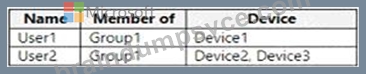
The devices are configured as shown in the following table.
You have a Conditional Access policy named CAPolicy1 that has the following settings:
1.Assignments
* Users or workload identities: Group1
* Cloud apps or actions: Office 365 SharePoint Online
* Conditions
- Filter for devices: Exclude filtered devices from the policy
- Rule syntax: device.displayName -startsWith "Device"
2.Access controls
* Grant
- Grant: Block access
* Session: 0 controls selected
3.Enable policy: On
For each of the following statements, select Yes if the statement is true. Otherwise, select No.
NOTE: Each correct selection is worth one point.
Answer:
Explanation:
Explanation:
Box 1: No
User1 is member of Group1 and has Device1.
Device1 is not Azure AD joined.
Note: Requiring a hybrid Azure AD joined device is dependent on your devices already being hybrid Azure AD joined.
Box 2: Yes
User2 is member of Group1 and has devices Device2 and Device3.
Device2 is Azure AD joined.
Device2 is excluded from CAPolicy1 (which would block access to Site1).
Box 3: Yes
User2 is member of Group1 and has devices Device2 and Device3.
Device3 is Android and is Azure AD registered.
Device3 is excluded from CAPolicy1 (which would block access to Site1).
Note: On Windows 7, iOS, Android, macOS, and some third-party web browsers, Azure AD identifies the device using a client certificate that is provisioned when the device is registered with Azure AD. When a user first signs in through the browser the user is prompted to select the certificate. The end user must select this certificate before they can continue to use the browser.
Reference:
https://learn.microsoft.com/en-us/azure/active-directory/devices/howto-hybrid-azure-ad-join
https://learn.microsoft.com/en-us/azure/active-directory/conditional-access/howto-conditional-access-policy- compliant-device
NEW QUESTION # 346
You have a Microsoft 365 E5 subscription that uses Microsoft Intune.
You have devices enrolled in Intune as shown in the following table.
You create the device configuration profiles shown in the following table.
Which profiles will be applied to each device? To answer, select the appropriate options in the answer area.
NOTE: Each correct selection is worth one point.
Answer:
Explanation:
Explanation: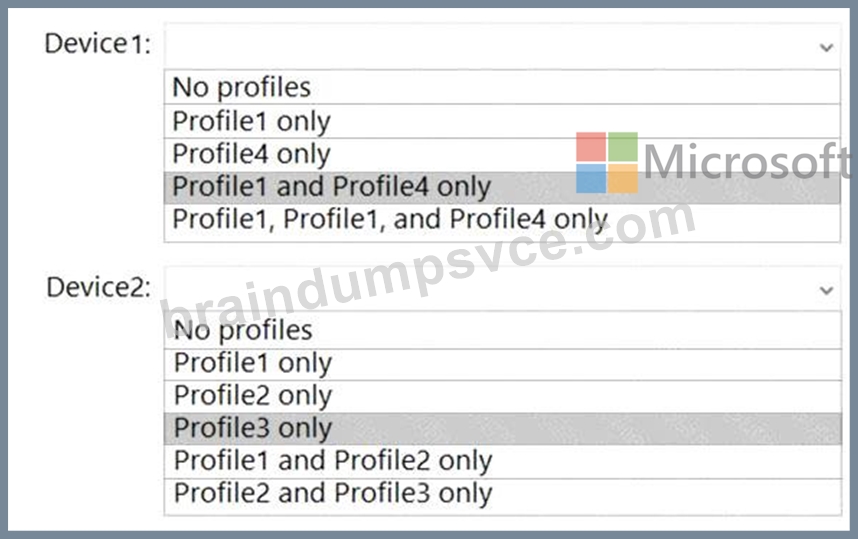
NEW QUESTION # 347
You have a Microsoft 365 E5 subscription that contains the devices shown in the following table.
You need to configure an incident email notification rule that will be triggered when an alert occurs only on a Windows 10 device. The solution must minimize administrative effort.
What should you do first?
- A. From the Microsoft 365 admin center, create a mail-enabled security group.
- B. From the Azure Active Directory admin center, create a dynamic device group.
- C. From the Microsoft 365 Defender portal, create a device group.
- D. From the Microsoft Endpoint Manager admin center, create a device category.
Answer: C
Explanation:
Reference:
https://docs.microsoft.com/en-us/microsoft-365/security/defender-endpoint/machine-groups?view=o365-worldw
https://docs.microsoft.com/en-us/microsoft-365/security/defender-endpoint/configure-email-notifications?view=
NEW QUESTION # 348
......
MS-102 Premium Files Practice Valid Exam Dumps Question: https://www.braindumpsvce.com/MS-102_exam-dumps-torrent.html
Get 100% Real MS-102 Accurate & Verified Answers As Seen in the Real Exam!: https://drive.google.com/open?id=1bOlZaDVEQOrkOG47k7OieCBShITa2Wg2