
Analytics-DA-201 Practice Test Give You First Time Success with 100% Money Back Guarantee!
All Obstacles During Analytics-DA-201 Exam Preparation with Analytics-DA-201 Real Test Questions
Salesforce Analytics-DA-201 Exam Syllabus Topics:
| Topic | Details |
|---|---|
| Topic 1 |
|
| Topic 2 |
|
| Topic 3 |
|
NEW QUESTION # 75
A Data Analyst at a coffee company has the following visualization already built.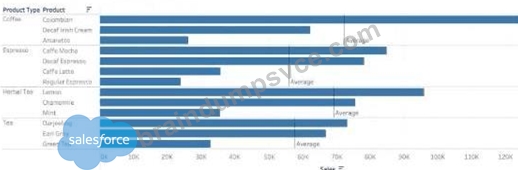
The analyst wants to make this more visually appealing by coloring the bars based on whether they are above or below the Average Sales within each Product Type.
Which calculation should the analyst use to calculate the Average Sales for each Product Type?
- A. ( FIXED [Product] : AVG( (FIXED [Product Type] : AVG( [Sales] ) ) )
- B. { FIXED [Product Type] : AVG( [Sales] ) }
- C. { EXCLUDE [Product] : SUM( [Sales] ) }
- D. : FIXED ([Product Type]) : AVG( [ FIXED [Product] : SUM( [Sales] ) ] )
Answer: D
NEW QUESTION # 76
You have a data source that contains the following columns.
You want to filter regions based on the highest sales. Users must be able to specify the number of regions shown.
Which three actions should you perform in order? (Place the three correct options in order. Use the arrows to move Options to Answer Area.
Use Answer Area arrows to re-order the options.)
Answer:
Explanation:
To filter regions based on the highest sales and allow users to specify the number of regions shown, you should perform these actions in order:
Answer area:
* Create an integer data type parameter named Param1.
* Drag Region to the Filters shelf.
* Configure a Top filter by field. Use Param1 and filter by the sum of Sales.
To create a dynamic filter that lets users choose the number of regions to display, you need to use a parameter and a top filter. A parameter is a user-defined variable that can be used in calculations, filters, and reference lines. A top filter is a type of filter that shows only the top or bottom N values based on a specified field or expression.
In this question, you want to filter regions based on the highest sales. You also want users to be able to specify the number of regions shown. To achieve this, you need to follow these steps:
* First, you need to create an integer data type parameter named Param1. This parameter will allow users to enter a number that will determine how many regions to show. You can create a parameter by right- clicking on the Data pane and selecting Create Parameter. Then, you need to specify the name, data type, current value, and allowable values for the parameter. In this case, you can choose Integer as the data type, 10 as the current value, and All as the allowable values. You also need to show the parameter control by right-clicking on the parameter and selecting Show Parameter Control. This will display a slider or a text box where users can enter or adjust the parameter value.
* Next, you need to drag Region to the Filters shelf. This will open the Filter dialog box, where you can choose how to filter the Region field. You can filter by general, wildcard, condition, or top. In this case, you want to filter by top, so you need to select the Top tab.
* Finally, you need to configure a top filter by field. Use Param1 and filter by the sum of Sales. This will filter the Region field by showing only the top N regions based on the sum of Sales, where N is the value of the parameter Param1. You can configure a top filter by field by selecting By field in the Top tab, then choosing the parameter Param1 from the drop-down list, and selecting the aggregation function Sum and the field Sales from the other drop-down lists. This will create a filter expression that looks like this: Top Param1 by SUM(Sales).
By following these steps, you will create a filter that shows only the regions with the highest sales, and allows users to change the number of regions shown by adjusting the parameter value.
References:
Tableau Certified Data Analyst Exam Prep Guide, page 10, section "Filtering Data" Tableau Help: Parameters Tableau Help: Top Filters
NEW QUESTION # 77
A Data Analyst has the following dataset.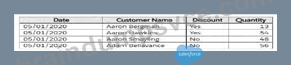
The analyst wants to create a parameter to dynamically filter the data to produce the following results based on quantity being above X value.
Which two types of parameters should the analyst use to produce the results? (Choose two)
- A. Integer
- B. Date
- C. Boolean
- D. Float
Answer: A,D
NEW QUESTION # 78
From Tableau Desktop you sign in lo a Tableau Server site.
What appears in the list of available data sources when you search for a published data source?
- A. All the data sources published to the Tableau Server within the folders to which you have access
- B. All the data sources published to the Tableau Server
- C. All the data sources published to the site within the folders to which you have access
- D. All the data sources published to the site
Answer: C
Explanation:
When you sign in to a Tableau Server site from Tableau Desktop and search for a published data source, you will see all the data sources published to the site within the folders to which you have access. You will not see data sources published to other sites or folders that you do not have permission to view. You can also filter your search by project, owner, or tag. References: https://help.tableau.com/current/pro/desktop/en-us
/connect_basic.htm https://help.tableau.com/current/pro/desktop/en-us/connect_tableauserver.htm When signed in to Tableau Server from Tableau Desktop, you'll only be able to see the data sources that have been published to the site and are within the folders that you have been granted access to. Tableau's permission and project structure mean that you won't see all data sources from the entire server unless you have permissions to do so.
NEW QUESTION # 79 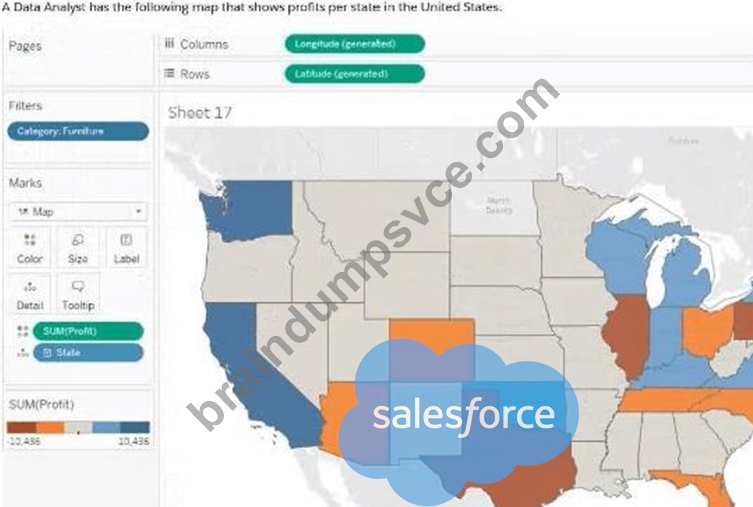
How are the colors configured for the map?
- A. A diverging color palette that has six stepped colors
- B. A sequential color gradient
- C. A diverging color palette that has five stepped colors
- D. A single color gradient
Answer: C
NEW QUESTION # 80
Open the link to Book1 found on the desktop. Open the sales dashboard.
Add the Sales by State sheet in a Show/Hide button to the right side of the dashboard.
Answer:
Explanation:
check the steps below in explanation.
Explanation:
To add the Sales by State sheet in a Show/Hide button to the right side of the dashboard, you need to do the following steps:
* Open the link to Book1 found on the desktop. This will open the Tableau workbook that contains the sales dashboard.
* Click on the sales dashboard tab at the bottom of the workbook to open the dashboard. You will see a dashboard that shows various charts and filters related to sales data.
* Drag Sales by State from the Sheets pane to the right side of the dashboard. This will add the sheet as a floating element on the dashboard. You can resize and position it as you like.
* Right-click on Sales by State and select Add Show/Hide Button from the menu. This will add a button that allows you to show or hide the sheet on the dashboard. You can customize the appearance and behavior of the button by clicking on it and using the options on the Marks card.
* Optionally, you can drag a vertical layout container from the Objects pane to the right side of the dashboard and place Sales by State and its button inside it. This will help you organize your dashboard elements and align them neatly.
References: https://help.tableau.com/current/pro/desktop/en-us/dashboards.htm https://help.tableau.com
/current/pro/desktop/en-us/dashboards_showhide.htm https://help.tableau.com/current/pro/desktop/en-us/dashboards_create_layouts.htm
NEW QUESTION # 81
You have the following dashboard that contains two sheets.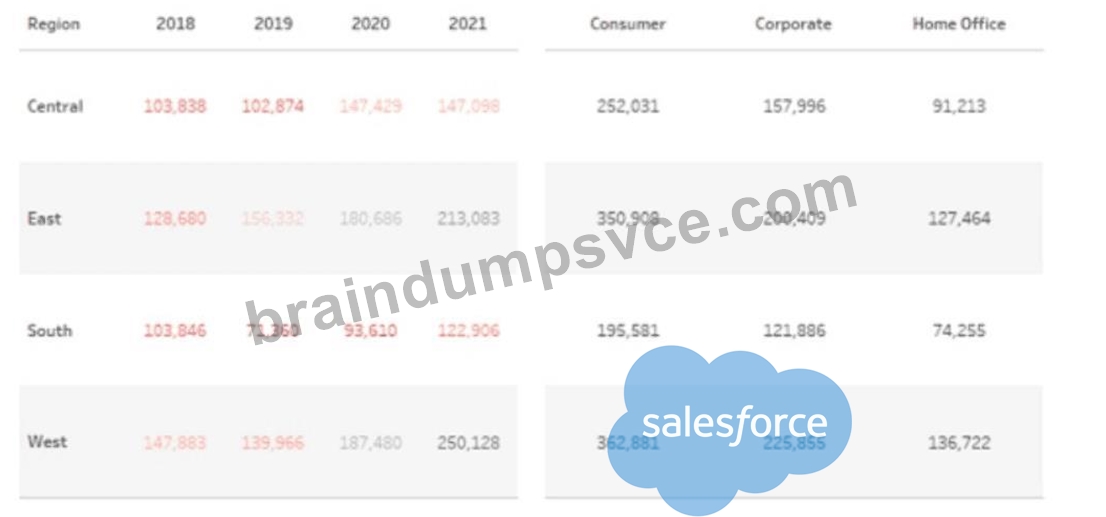
You want to minimize the whitespace between the sheets.
What should you configure?
- A. The size
- B. The background
- C. The position
- D. The border
- E. The padding
Answer: E
Explanation:
To minimize the whitespace between the sheets, you should configure the padding of the sheets and the dashboard. Padding is the amount of space between the edge of a sheet or dashboard and its content. You can adjust the padding by using the Layout tab in the Format pane. You can reduce the padding for each sheet by selecting the sheet and changing the values for the inner and outer padding. You can also reduce the padding for the dashboard by selecting the dashboard and changing the values for the outer padding. Reducing the padding will make the sheets and the dashboard more compact and eliminate unnecessary whitespace. References:
* Format Dashboards - Tableau
* Tableau Certified Data Analyst Study Guide
NEW QUESTION # 82
You have the Mowing two tables that contains data about the books in a library.

Both tables are incomplete so there are books missing from the tables.
You need to combine the tables. The solution must ensure that all the data is retained Which type of join should you use?
- A. left join
- B. Right join
- C. Full outer join
- D. Inner join
Answer: C
Explanation:
To combine the two tables that contain data about books in a library and ensure that all the data is retained, you should use a full outer join. A full outer join is a type of join that returns all rows from both tables, regardless of whether there is a match or not. If there is no match, null values are filled in for the missing fields.
To perform a full outer join, you need to do the following steps:
* Connect to both tables as your data sources in Tableau. You can use either live or extract connections.
* Drag one table to the canvas and drop it on top of another table. This will create a join between them based on a common field.
* Click on the join icon between the tables and select Full Outer Join from the drop-down list. This will change the join type to full outer join and show all rows from both tables.
* Optionally, you can add or remove join clauses by clicking on Add or Remove buttons next to each clause. You can also change or rename fields by clicking on them.
The other types of joins are not correct for this scenario. An inner join returns only the rows that have a match in both tables, which will exclude any books that are missing from either table. A left join returns all rows from the left table and only the matching rows from the right table, which will exclude any books that are only in the right table. A right join returns all rows from the right table and only the matching rows from the left table, which will exclude any books that are only in the left table. References: https://help.tableau.com
/current/pro/desktop/en-us/joining_tables.htm https://help.tableau.com/current/pro/desktop/en-us/join_types.
htm
When combining two datasets that are both incomplete and where it's important to retain all data from both sources, a full outer join is appropriate. This type of join ensures that all records from both tables are included in the combined dataset, even if there are no matching records in the other table.
NEW QUESTION # 83
You want to ensure that when you click a bar on a dashboard, a tooltip appears that contains a link named
"Click here to know more!" as shown in the following exhibit.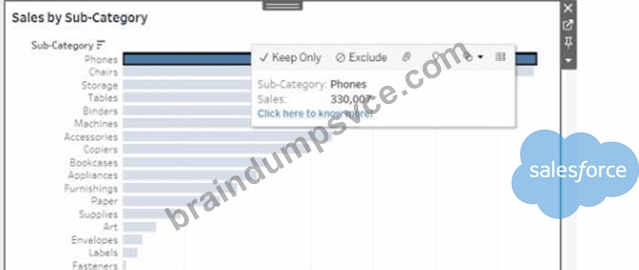

Answer:
Explanation: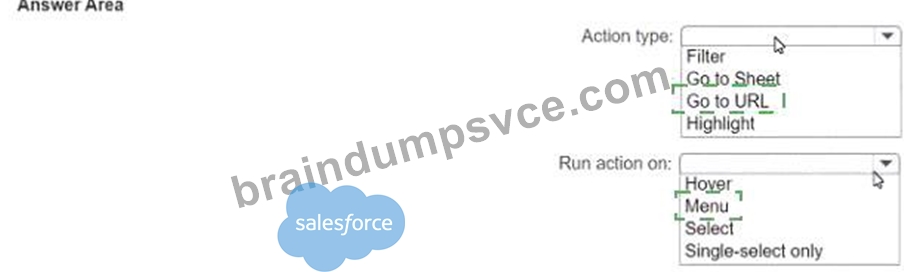
Explanation:
NEW QUESTION # 84
A Data Analyst is given the following table and asked to create a flow that adds a date field to the data. This field should automatically update as new dates (months) are added to the original table.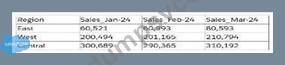
Which technique should the analyst use as the first step to achieve this in Tableau Prep?
- A. A Rows to Columns Pivot step
- B. An Aggregate step to reshape the data
- C. A wildcard search to pivot in the Pivot step
- D. A wildcard search for multiple tables in the Input step
Answer: C
NEW QUESTION # 85
You have a dataset that contains sates data. The following is a sample of the data.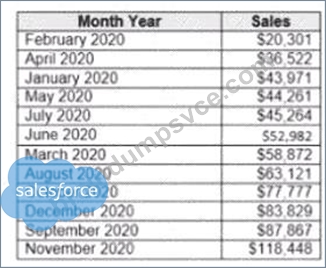
You need to return a value of true if a month has sales greater than $50 000. otherwise the formula must return a value of false.
Which two formulas achieve the goal Choose two
- A. [Sales] > 50000
- B. IIF(SUM< [Sales] )>50000, TRUE, FALSE)
- C. SUM{[Sales]) IN (50000)
- D. MAX< [Sales], 50000)
Answer: A,B
Explanation:
The two formulas that will return a value of true if a month has sales greater than $50,000, otherwise the formula must return a value of false, are:
B). IIF(SUM([Sales]) > 50000, TRUE, FALSE) D. [Sales] > 50000
The IIF function is a logical function that returns one value if a condition is true, and another value if the condition is false. In this case, the condition is SUM([Sales]) > 50000, which means that the sum of sales for a month is greater than $50,000. The function will return TRUE if the condition is true, and FALSE if the condition is false.
The comparison operator > is a logical operator that returns TRUE if the left operand is greater than the right operand, and FALSE otherwise. In this case, the operands are [Sales] and 50000, which means that the sales for a month are greater than $50,000. The operator will return TRUE if the sales are greater than $50,000, and FALSE otherwise.
The other options are not correct for this scenario. The IN function is a logical function that returns TRUE if a value is in a set of values, and FALSE otherwise. In this case, the value is SUM([Sales]), which is not in the set of values (50000). The function will always return FALSE. The MAX function is an aggregation function that returns the maximum value in a field or expression. In this case, the field or expression is [Sales], 50000, which is not valid syntax. The function will return an error. References: https://help.tableau.com/current/pro
/desktop/en-us/functions_functions_logical.htm#IIF https://help.tableau.com/current/pro/desktop/en-us
/operators.htm https://help.tableau.com/current/pro/desktop/en-us/functions_functions_aggregate.htm#MAX
NEW QUESTION # 86
You are creating an annual report in Microsoft Word.
In Tableau Desktop, you build a chart in a worksheet.
You want to create an image of the chart that you can add to the annual report.
What are two ways to create the image? Choose two.
- A. From the Worksheet menu, use the Export option.
- B. From the File menu, use the Export As Version option.
- C. From the Worksheet menu, use the Copy option.
- D. From the Dashboard menu, use the Export Image option.
- E. From the Dashboard menu, use the Copy Image option.
Answer: A,C
Explanation:
To create an image of the chart that you can add to the annual report, you can use either the Export option or the Copy option from the Worksheet menu. The Export option will allow you to save the image as a file in a specified location, name, and format. The Copy option will allow you to copy the image to the clipboard and paste it into another application, such as Microsoft Word. Both options will let you choose which elements to include in the image, such as title, caption, legend, etc. References:
* Export Views from Tableau Desktop to Another Application
* Copy and Paste Views from Tableau Desktop to Another Application
NEW QUESTION # 87
You want to connect a Tableau workbook to a dataset in a Microsoft Excel spreadsheet.
What should you do from Tableau Desktop?
- A. From the File menu select Import Workbook
- B. From the File menu select New
- C. From the Data menu select New Data Source
- D. From the Data menu select Replace Data Source
Answer: C
Explanation:
To connect a Tableau workbook to a dataset in a Microsoft Excel spreadsheet, you need to select New Data Source from the Data menu. This will open the Connect pane, where you can choose Microsoft Excel as your data source and browse for your spreadsheet file. You can then drag and drop your sheets or tables to join or union them in the data source page. References: https://help.tableau.com/current/pro/desktop/en-us
/connect_basic.htm https://help.tableau.com/current/pro/desktop/en-us/connect_excel.htm When connecting to a dataset in Tableau Desktop, you would go to the 'Data' menu and select 'New Data Source'. This allows you to connect to various types of data sources, including Microsoft Excel spreadsheets, where you can then select the specific file you wish to connect to.
NEW QUESTION # 88
You have the following dataset.
When you use the dataset in a worksheet, you want Sales to appear automatically as shown in the following table.
What should you do?
- A. Change the default number format of the Sales told
- B. Create a calculated field that uses a formula of 'S' + stri < (Sales)/1000)).
- C. Create a calculated field that uses a formula of 'S' * str (Round((sales],2)) + 'k'
- D. Change the data type of the Sates field to Siring
Answer: A
Explanation:
To make Sales appear automatically as shown in the second table, you should change the default number format of the Sales field. The default number format is how Tableau displays a field when you drag it to a worksheet. You can change the default number format by right-clicking on the field and selecting Default Properties > Number Format from the menu. This will open a dialog box where you can choose a category, such as Currency or Percentage, and customize the options, such as decimal places or prefixes.
In this case, you want to change the default number format of Sales to Currency with zero decimal places and a custom prefix of "S". This will make Sales appear as "S" followed by the rounded value in thousands.
The other options are not correct for this scenario. Changing the data type of Sales to String will not affect how it appears on a worksheet. Creating a calculated field that uses a formula will not change the default number format of Sales, but create a new field that you have to drag to a worksheet. Converting Sales to Attribute will return only one value for each partition of data, which will not show any variation over time.
References: https://help.tableau.com/current/pro/desktop/en-us/formatting.htm https://help.tableau.com/current
/pro/desktop/en-us/formatting_change_default.htm
To achieve the formatting as shown in the example, where sales figures are displayed with a "K" to represent thousands and rounded to the nearest thousand (e.g., $20K, $44K, etc.), you would need to adjust the default number format of the Sales field in Tableau. By changing the default number format, every instance where the Sales field is used would automatically reflect this new formatting. This is more efficient than creating a calculated field as it preserves the numeric nature of the field, allowing for further numerical operations and aggregations.
NEW QUESTION # 89
Open the link to Book1 found on the desktop. Open Disciplines worksheet.
Filter the table to show the Top 10 NOC based on the number of medals won.
Answer:
Explanation:
check the steps below in explanation.
Explanation:
To filter the table to show the Top 10 NOC based on the number of medals won, you need to do the following steps:
* Open the link to Book1 found on the desktop. This will open the Tableau workbook that contains the Disciplines worksheet.
* Click on the Disciplines tab at the bottom of the workbook to open the worksheet. You will see a table that shows the NOC, discipline, and medals for each country.
* Drag Medals from the Measures pane to the Filters shelf. This will open a dialog box that allows you to filter by different criteria.
* Select Top from the dialog box. This will show you options to filter by the top or bottom values of a field.
* Enter 10 in the text box next to By field. This will filter by the top 10 values of Medals.
* Select NOC from the drop-down list next to By field. This will filter by the top 10 values of NOC based on Medals.
* Click OK to apply the filter. You will see that the table now shows only 10 rows, one for each NOC with the highest number of medals.
References: https://help.tableau.com/current/pro/desktop/en-us/filtering.htm https://help.tableau.com/current
/pro/desktop/en-us/filtering_topn.htm
NEW QUESTION # 90
You have the following primary data source that contains a dimension named Dorm_Code.
You receive the following secondary data source that contains updated dorm codes.
You need to bring the updated dorm codes into Tableau and use the codes in existing visualizations. The new dorm codes must use the existing field name of Dorm_Code.
What should you do?
- A. Bring in the secondary data source by using relationships. From the Data pane, right-click Dorm_Name select Replace References, and then select Dorm_Name_New
- B. Bring in the secondary data source as a union.
- C. Bring in the secondary table as a left join to the primary data source. From the Data Source page, select Create Calculated Field in the Dorm_Name field and enter [Dcrm_Name_New] in the calculation window
- D. Create a data blend and select Edit Primary Aliases to replace the primary data source alias values with values from the secondary data source
Answer: A
Explanation:
* Using relationships: You can use relationships to link the secondary data source with the primary data source based on a common field. This will allow you to use fields from both data sources in your visualization without creating new fields or duplicating data. You can then replace references to update the dimension values. For example, you can use relationships to link the updated dorm codes with the primary data source and then replace Dorm_Code with Dorm_Code_New in your visualization.
https://community.tableau.com/s/question/0D54T00000C5ldZSAR/update-data-view-based-on-dimension To update existing visualizations with new codes without changing the field name, using relationships to bring in the secondary data source is appropriate. Then using Replace References allows you to update the references from the old dorm codes to the new ones while maintaining the existing field name.
NEW QUESTION # 91
You have the following table.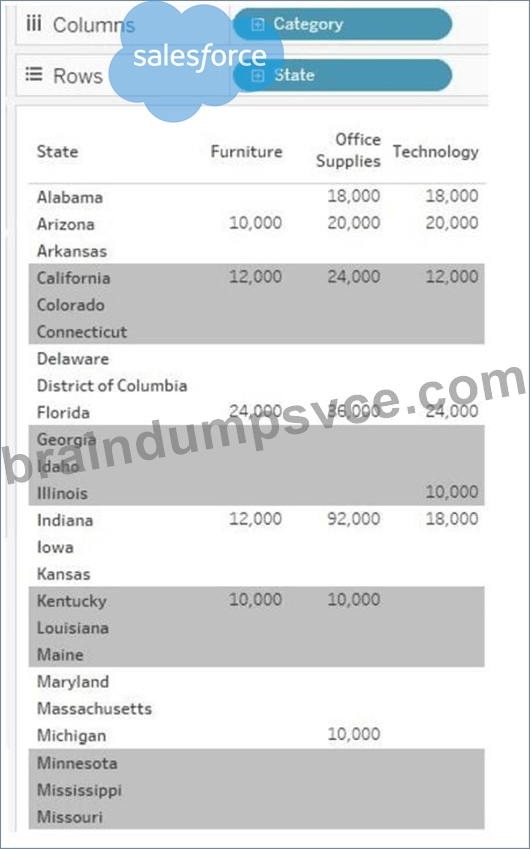
You need each record to alternate between grey and white.
What should you change in the Format Shading pane?
- A. the row banding size to 3
- B. the column banding size to 1
- C. the row banding size to 1
- D. the column banding size to 3
Answer: C
Explanation:
To have each record alternate between grey and white, you should change the row banding size to 1 in the Format Shading pane. This setting will ensure that each row has a different shading from the one above and below it, creating an alternating pattern of grey and white rows. References: The answer can be verified through practical application within Tableau or by consulting Tableau's official learning resources, such as Tableau Help: Format Shading or Tableau Training Pass: Formatting.
NEW QUESTION # 92
You have the following Map.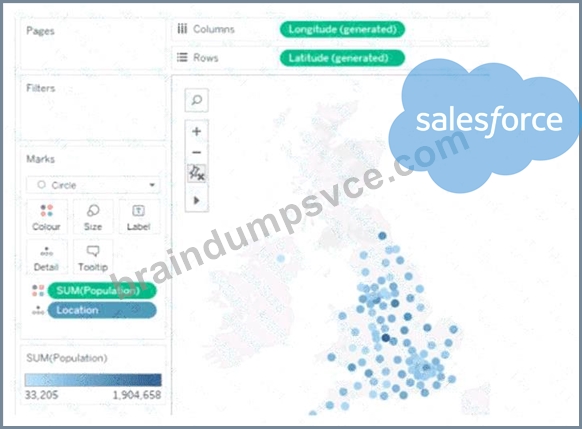
You need the map to appear as shown in the following visualization.
What should you do?
- A. Change the mark type to Density.
- B. Drag Location to Size on the Marks card.
- C. Change the opacity to 75%.
- D. Drag Population to Size on the Marks card.
- E. Change the mark type to Map.
Answer: A
Explanation:
To create a map visualization that shows the concentration of data points in different locations, you need to change the mark type to Density. This will create a heatmap that uses color and size to indicate the density of the data points. You can also adjust the intensity and transparency of the density marks to suit your needs. References: The information is based on the following sources:
* Create Heatmaps that Show Trends or Density in Tableau
* Build a Simple Map - Tableau
NEW QUESTION # 93
You have the following dashboard.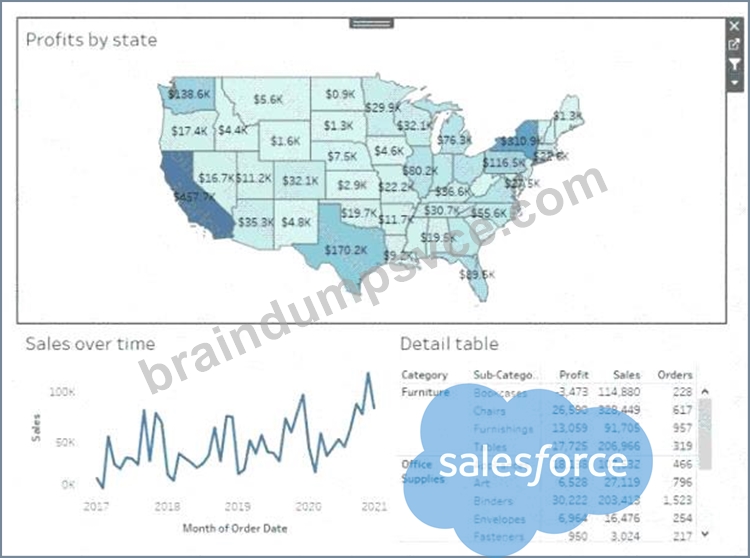
From the context menu of Sales over time, select Ignore Actions.
Several Lays later, you decide that you want to filter both Sales over time and Detail table by selecting a data point on the map.
What should you do?
- A. From the context menu of Sales over time, select Use as Filter and then deselect Use as Filter
- B. From the context menu of Detail table, select Ignore Actions.
- C. From the context menu of Sales over lime, select Filters and then select Enable Auto Update.
- D. From the context menu of Profits by state, deselect Use as Filter and then select Use as Filter.
Answer: D
NEW QUESTION # 94
You are developing a data source in Tableau Prep.
You have two tables named Orders and Employees.
The Orders table was created in 2019 and contains the following columns.
The Employees table contains all the employee information for the various sales teams in the sales department and contains the following columns You want to prepare the data so that you can analyze sales trends over time for every sales team.
Which three actions should you perform in order? (Place the three correct options in order. Use the arrows to move Options to Answer Area. Use Answer Area arrows to re-order the options.)
Answer:
Explanation:
There are different ways to prepare the data in Tableau Prep, but one possible answer is:
Answer area:
* Join the tables.
* Aggregate the data by Sales Team.
* Add the following filter to the Employees table: Sale Team - Team Alpha.
To analyze sales trends over time for every sales team, you need to combine the data from the Orders and Employees tables. You can do this by joining the tables on the Rep ID column, which is a common identifier for both tables. This will create a single table with all the columns from both tables. Next, you need to aggregate the data by Sales Team, which is the level of analysis you want. You can do this by grouping the data by the Sales Team column and applying an aggregation function (such as sum, average, count, etc.) to the other columns that you want to measure (such as Total Amount, Rep Tenure, etc.). This will create a summary table with one row for each sales team and the aggregated values for the other columns. Finally, you need to filter the data to focus on a specific sales team, such as Team Alpha. You can do this by adding a filter to the Employees table and selecting only the rows where Sales Team equals Team Alpha. This will remove the rows for other sales teams and keep only the data for Team Alpha.
References:
[Tableau Certified Data Analyst Exam Prep Guide], page 9, section "Preparing Data"
[Tableau Help: Join Your Data]
[Tableau Help: Aggregate Your Data]
[Tableau Help: Filter Your Data]
NEW QUESTION # 95
A Data Analyst has the following dataset: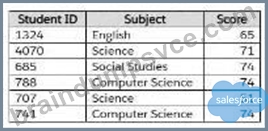
The analyst wants to create a new calculated dimension field named Category that meets the following conditions:
When Subject is Computer Science or Science, the Category must be Sciences.
When Subject is English or Social Studies, the Category must be Humanities.
Which two logical functions achieve this goal? (Choose two.)
- A. IF [Subject] = 'Science' THEN 'Sciences'
ELSEIF [Subject] = 'English' THEN 'Humanities'
ELSEIF [Subject] = 'Social Studies' THEN 'Humanities'
ELSEIF [Subject] = 'Computer Science' THEN 'Sciences'
END - B. CASE [Subject]
WHEN 'Computer Science' THEN 'Sciences'
WHEN 'English' THEN 'Humanities'
WHEN 'Social Studies' THEN 'Humanities'END - C. IF ENDSWITH([Subject], 'Computer Science') THEN 'Sciences' ELSE 'Humanities' END
- D. IIF((CONTAINS([Subject], 'Science') = TRUE), 'Humanities', 'Sciences')
Answer: A,B
NEW QUESTION # 96
A Data Analyst has the following chart.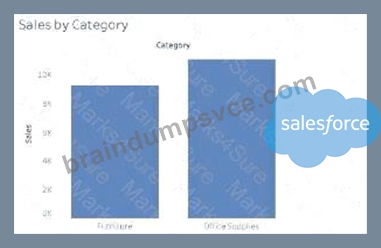
The analyst needs to enable the drilldown from Category to Subcategory as shown in the following chart.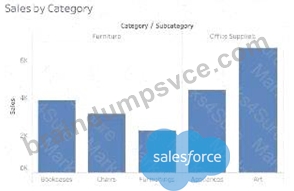
What should the analyst create?
- A. A combined set for Category and Subcategory
- B. A group of Category and Subcategory
- C. A bin for Category and a bin for Subcategory
- D. A hierarchy of Category and Subcategory
Answer: D
NEW QUESTION # 97
A Data Analyst is creating a new dashboard.
The analyst needs to add a button to the dashboard that allows users to export the dashboard as an image.
Which type of object should the analyst use?
- A. Navigation
- B. Extension
- C. Download
- D. Image
Answer: C
NEW QUESTION # 98
You have the following table.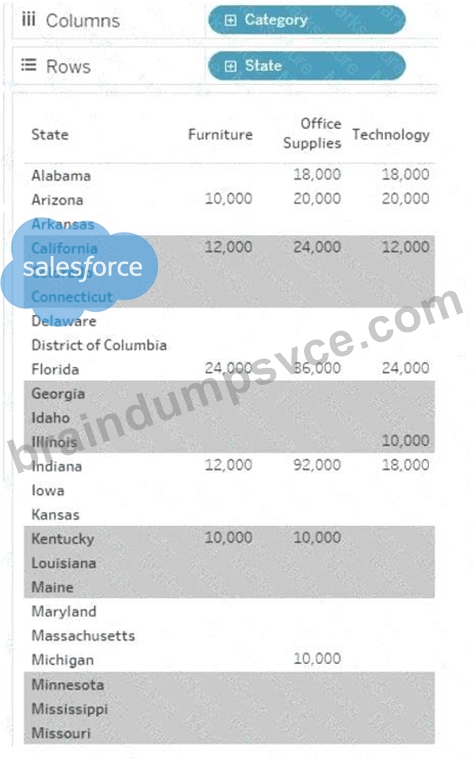
You need each record to alternate between grey and white.
What should you change in the Format Shading pane?
- A. the row banding size to 3
- B. the column banding size to 1
- C. the row banding size to 1
- D. the column banding size to 3
Answer: C
Explanation:
To have each record alternate between grey and white, you should change the row banding size to 1 in the Format Shading pane. This setting will ensure that each row has a different shading from the one above and below it, creating an alternating pattern of grey and white rows. References: The answer can be verified through practical application within Tableau or by consulting Tableau's official learning resources, such as Tableau Help: Format Shading or Tableau Training Pass: Formatting.
NEW QUESTION # 99
......
Fully Updated Free Actual Salesforce Analytics-DA-201 Exam Questions: https://www.braindumpsvce.com/Analytics-DA-201_exam-dumps-torrent.html
Free Analytics-DA-201 Questions for Salesforce Analytics-DA-201 Exam [Jun-2026]: https://drive.google.com/open?id=1TImNQmW_A4cLP_bAU2lIaDD7epsQWsFP