
View 2V0-21.23 Exam Question Dumps With Latest Demo [Apr 17, 2026]
Free 2V0-21.23 Test Questions Real Practice Test Questions
VMware 2V0-21.23 exam is one of the most sought-after certifications in the IT industry. VMware vSphere 8.x Professional certification is recognized globally and validates an individual's skills and expertise in managing and operating a vSphere 8.x environment. By passing 2V0-21.23 exam, IT professionals can demonstrate their proficiency in using vSphere 8.x to manage virtualized infrastructure.
VMware 2V0-21.23 exam is designed for professionals who are interested in validating their skills in configuring, deploying, and managing VMware vSphere 8.x environments. 2V0-21.23 exam is a professional-level certification that is recognized globally, providing a valuable opportunity for IT professionals to enhance their career prospects. 2V0-21.23 exam is designed to validate the candidate's knowledge of advanced vSphere administration concepts and skills.
NEW QUESTION # 18
An administrator notices a Fibre Channel adapter in an ESXi host has been experiencing inconsistent connectivity states Which trigger can be used to quickly identify the issue and alert the administrator so that the issue can be resolved?
- A. Lost Network Path Redundancy
- B. Lost Network Connectivity
- C. Host Connection Lost
- D. Lost Storage Connectivity
Answer: A
Explanation:
Explanation
Complicated, the question does not comment on whether the path is redundant, if not redundant the correct answer would be D, but if we take into account good practices, the FC would be redundant.
https://kb.vmware.com/s/article/2014553
Book course: 6-23 Fibre Channel SAN Components Using SAN switches, you can set up path redundancy to address any path failures from host server to switch, or from storage array to switch. 6-25 Multipathing with Fibre Channel By default, ESXi hosts use only one path from a host to a given LUN at any one time. If the path actively being used by the ESXi host fails, the server selects another available path.
NEW QUESTION # 19
An administrator needs better performance and near-zero CPU utilization from the ESXI hosts for networking functions and processing. The administrator creates a new vSphere Distributed Switch and enables network offloads compatibility.
Which solution would help achieve this goal?
- A. Data Processing Units (DPUs)
- B. vSphere Network I/O Control
- C. VSphere Distributed Services Engine
- D. Universal Passthrough version 2
Answer: A
Explanation:
The solution that would help achieve better performance and near-zero CPU utilization from the ESXi hosts for networking functions and processing is Data Processing Units (DPUs), which are specialized processors that offload network services from the CPU and provide hardware acceleration.
https://docs.vmware.com/en/VMware-vSphere/8.0/vsphere-networking/GUID-41AB1101-D943-490A-BF1A-E53433855C07.html
NEW QUESTION # 20
An administrator is asked to segregate virtual machine (VM) traffic by VLAN on a vSphere standard switch The following requirements must be met:
*VLAN ID on the switch port group must be 4095.
*VLAN tagging must be done at the VM level.
Which tagging mode is required?
- A. Virtual Switch Tagging (VST)
- B. None
- C. Virtual Guest Tagging (VGT)
- D. External Switch Tagging (EST)
Answer: C
Explanation:
Explanation
The tagging mode that is required is Virtual Guest Tagging (VGT), which allows VLAN tagging to be done at the VM level. VGT requires that the VLAN ID on the switch port group be set to 4095, which is a special value that indicates that packets from all VLANs are allowed to pass through. References:
https://docs.vmware.com/en/VMware-vSphere/7.0/com.vmware.vsphere.networking.doc/GUID-D35A0A1C-B6
https://kb.vmware.com/s/article/1003806
NEW QUESTION # 21
An administrator has a requirement to revert a running virtual machine to a previous snapshot after a failed attempt to upgrade an application. When the administrator originally took the snapshot, the following choices in the Take Snapshot dialog were made:
* Snapshot the virtual machine's memory = false
* Quiesce guest file system = false
What will be the result of the administrator selecting the "Revert to Latest Snapshot" option to return the virtual machine to a previous snapshot?
- A. The virtual machine will be restored to the child snapshot in a powered on state.
- B. The virtual machine will be restored to the parent snapshot in a powered off state.
- C. The virtual machine will be restored to the parent snapshot in a powered on state.
- D. The virtual machine will be restored to the child snapshot in a powered off state.
Answer: B
Explanation:
Explanation
The result of selecting "Revert to Latest Snapshot" option to return a VM without memory snapshot or quiesced guest file system is that it will be restored to its parent snapshot in a powered off state.
References:
https://docs.vmware.com/en/VMware-vSphere/7.0/com.vmware.vsphere.monitoring.doc/GUID-C3FFBF62-D6B
https://docs.vmware.com/en/VMware-vSphere/7.0/com.vmware.vsphere.monitoring.doc/GUID-C3FFBF62-D6B
NEW QUESTION # 22
To keep virtual machines (VMs) up and running at all times in a vSphere cluster, an administrator would like VMs to be migrated automatically when the host hardware health status becomes degraded.
Which cluster feature can be used to meet this requirement?
- A. vSphere HA Orchestrated Restart
- B. vSphere Fault Tolerance
- C. Proactive HA
- D. Predictive DRS
Answer: C
Explanation:
Explanation
Proactive HA is a cluster feature that can be used to migrate VMs automatically when the host hardware health status becomes degraded, before a failure occurs.
References:
https://docs.vmware.com/en/VMware-vSphere/7.0/com.vmware.vsphere.avail.doc/GUID-C3FFBF62-D6BF-4A5
NEW QUESTION # 23
An administrator is tasked with looking into the disaster recovery (DR) options for a software-defined data center (SDDC).
The following requirements must be met:
*All virtual machines (VMs) must be protected to a secondary site.
*The source VMs must remain online until the failover.
*When failing over to the secondary site, application downtime is allowed
*The DR failover must be managed from the vSphere Client.
*Costs must remain as low as possible.
How can the administrator accomplish this task?
- A. Configure a subscribed content library on the secondary site.
- B. Configure VMware Site Recovery Manager and combine it with array-based storage replication.
- C. Configure VMware Cloud Disaster Recovery (VCDR) and combine it with array-based storage replication
- D. Configure VMware a Site Recovery Manager and combine it with vSphere Replication.
Answer: D
Explanation:
Explanation
https://blogs.vmware.com/virtualblocks/2017/11/29/vsr-technicaloverview/
NEW QUESTION # 24
An administrator is investigating reports of users experiencing difficulties logging into a VMware vCenter instance using LDAP accounts.
Which service should the administrator check as part of troubleshooting?
- A. Lookup Service
- B. VMware Authentication Framework Daemon
- C. vSphere Authentication Proxy Service
- D. Identity Management Service
Answer: D
Explanation:
Explanation
Identity Management Service is the service that handles authentication requests from LDAP accounts and other identity sources in vCenter Server.
References:
https://docs.vmware.com/en/VMware-vSphere/7.0/com.vmware.vcenter.install.doc/GUID-FE1D5F2E-E3AC-4D
NEW QUESTION # 25
After a recent unexplained peak in virtual machine (VM) CPU usage, an administrator is asked to monitor the VM performance for a recurrence of the issue.
Which two tools can the administrator use? (Choose two.)
- A. vSphere Performance Charts
- B. ESXi Shell
- C. vCenter Command Line Interface
- D. Direct Console User Interface (DCUI)
- E. vCenter Management Interface
Answer: A,B
Explanation:
Explanation
To monitor the VM performance for a recurrence of the issue, the administrator can use vSphere Performance Charts, which provide graphical views of various performance metrics for VMs and other objects; or ESXi Shell, which provides command-line access to ESXi hosts and allows running various commands to collect performance data.
References:
https://docs.vmware.com/en/VMware-vSphere/7.0/com.vmware.vsphere.monitoring.doc/GUID-D89E8267-C74A
https://docs.vmware.com/en/VMware-vSphere/7.0/com.vmware.vsphere.monitoring.doc/GUID-CDC20FD2-FE1
NEW QUESTION # 26
Refer to the exhibit.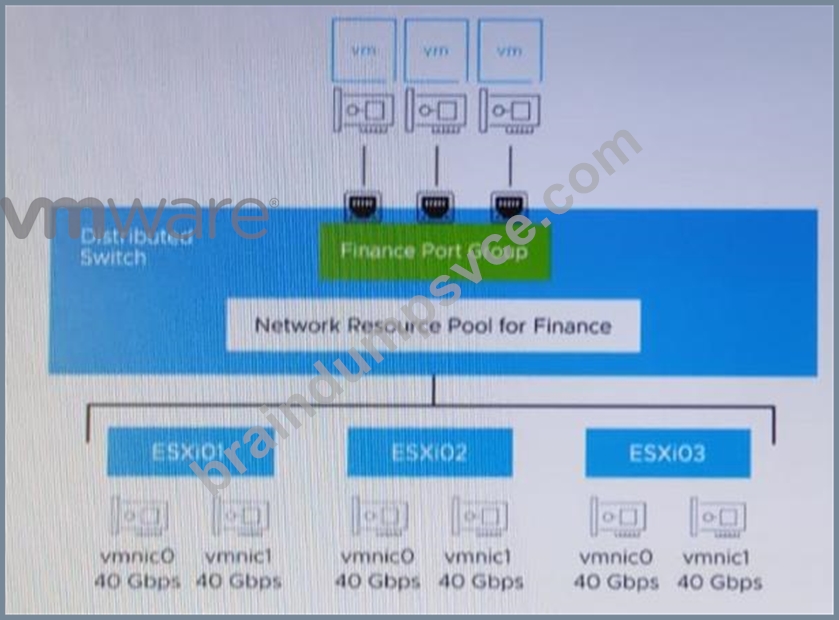
An administrator set up the following configuration:
* The distributed switch has three ESXi hosts, and each host has two 40 Gbps NICs.
* The amount of bandwidth reserved for virtual machine (VM) traffic is 6 Gbps.
The administrator wants to guarantee that VMs in the Finance distributed port group can access 50 percent of the available reserved bandwidth for VM traffic. k Given this scenario, what should the size (in Gbps) of the Finance network resource pool be?
- A. 0
- B. 1
- C. 2
- D. 3
Answer: A
Explanation:
Explanation
The size of the Finance network resource pool should be 50 percent of the reserved bandwidth for VM traffic, which is 6 Gbps x 3 hosts = 18 Gbps.
References:
https://docs.vmware.com/en/VMware-vSphere/7.0/com.vmware.vsphere.networking.doc/GUID-9F1D4E96-3392
NEW QUESTION # 27
An administrator manually configures a reference ESXi host that meets company security standards for vSphere environments. The administrator now needs to apply all of the security standards to every identically configured host across multiple vSphere clusters within a single VMware vCenter instance.
Which four steps would the administrator complete to meet this requirement? (Choose four.)
- A. Extract the host profile from the reference host
- B. Export the host profile from vCenter.
- C. Check the compliance of each host against the host profile.
- D. Remediate all non-compliant hosts.
- E. Reset host customization on the reference host.
- F. Import host customization on the reference host.
- G. Attach the host profile to each cluster that requires the secure configuration.
Answer: A,C,D,G
Explanation:
Explanation
To apply the security standards from a reference host to other hosts across multiple clusters, the administrator needs to extract a host profile from the reference host, which captures its configuration settings; attach the host profile to each cluster that requires the same configuration; check the compliance of each host against the host profile, which compares their settings; and remediate all non-compliant hosts, which applies the configuration settings from the host profile.
References:
https://docs.vmware.com/en/VMware-vSphere/7.0/com.vmware.vsphere.security.doc/GUID-F8F105EC-A6EA-4
NEW QUESTION # 28
An administrator has mapped three vSphere zones to three vSphere clusters.
Which two statements are true for this vSphere with Tanzu zonal Supervisor enablement? (Choose two.)
- A. One Supervisor will be created across all zones.
- B. One Supervisor will be created in a specific zone.
- C. Individual vSphere Namespaces will be placed into a specific zone.
- D. Three Supervisors will be created in Linked Mode.
- E. Individual vSphere Namespaces will be spread across all zones.
Answer: A,E
Explanation:
For a vSphere with Tanzu zonal Supervisor enablement where three vSphere zones are mapped to three vSphere clusters, the following two statements are true:
B) One Supervisor will be created across all zones. In a three-zone deployment, all three vSphere clusters become one Supervisor.
E) Individual vSphere Namespaces will be spread across all zones. You can distribute the nodes of your Tanzu Kubernetes Grid clusters across all three vSphere zones, thus providing HA for your Kubernetes workloads at a vSphere cluster level.
NEW QUESTION # 29
An administrator is tasked with configuring an appropriate Single Sign-On (SSO) solution for VMware vCenter based on the following criteria:
* The solution should support the creation of Enhanced Link Mode groups.
* All user accounts are stored within a single Active Directory domain and the solution must support only this Active Directory domain as the identity source.
* All user account password and account lockout policies must be managed within the Active Directory domain.
* The solution should support token-based authentication.
Which SSO solution should the administrator choose based on the criteria?
- A. vCenter Single Sign-On with Active Directory (Windows Integrated Authentication) as the identity source
- B. vCenter Identity Provider Federation with Active Directory Federation Services as the identity provider
- C. vCenter Identity Provider Federation with Active Directory over LDAP as the identity provider
- D. vCenter Single Sign-On with Active Directory over LDAP as the identity source
Answer: A
Explanation:
Explanation
Option C is correct because it indicates that vCenter Single Sign-On with Active Directory (Windows Integrated Authentication) as the identity source is the best SSO solution for VMware vCenter based on the criteria, as this solution supports Enhanced Link Mode groups, supports only one Active Directory domain as the identity source, delegates password and account lockout policies to Active Directory, and supports token-based authentication. Option A is incorrect because vCenter Identity Provider Federation with Active Directory Federation Services as the identity provider is not necessary for a single Active Directory domain scenario and may introduce additional complexity and overhead. Option B is incorrect because vCenter Single Sign-On with Active Directory over LDAP as the identity source does not support token-based authentication and may require additional configuration for password and account lockout policies. Option D is incorrect because vCenter Identity Provider Federation with Active Directory over LDAP as the identity provider does not support token-based authentication and may introduce additional complexity and overhead. References:
https://docs.vmware.com/en/VMware-vSphere/7.0/com.vmware.vcenter.install.doc/GUID-A2A4371A-B888-404
NEW QUESTION # 30
An administrator creates a new corporate virtual machine (VM) template every month to include all of the latest patches. The administrator needs to ensure that the new VM template is synchronized from the primary data center site (London) to two secondary data center sites (Tokyo and New York). The administrator is aware that datastore space is limited within the secondary data center sites. The administrator needs to ensure that the VM template is available in the secondary sites the first time a new virtual machine is requested.
Which four steps should the administrator take to meet these requirements? (Choose four.)
- A. Add the virtual machine template to the published content library.
- B. Configure each subscribed content library to download content immediately.
- C. Create a new published content library at the primary site.
- D. Add the virtual machine template to the subscribed content library.
- E. Create a new published content library in each secondary site.
- F. Create a new subscribed content library in each secondary site.
- G. Configure the subscribed content library to download content when needed.
Answer: A,C,F,G
Explanation:
To meet the requirements of synchronizing and protecting images and templates with limited datastore space, the administrator needs to create a new published content library at the primary site, which makes it available for subscription by other vCenter Server instances; create a new subscribed content library in each secondary site, which allows accessing content from a published content library; configure the subscribed content library to download content when needed, which saves datastore space by only downloading content on demand; and add the virtual machine template to the published content library, which makes it available for other hosts to use.
NEW QUESTION # 31
Following a merger with another company, an administrator is tasked with configuring an identity source for VMware vCenter so that all vSphere administrators can authenticate using their existing Active Directory accounts. Each company has user accounts in their own Active Directory forests.
The following additional information has been provided:
* The corporate policy states that only Windows-based machine accounts are allowed in Active Directory.
Which action should the administrator take to configure vCenter Single Sign-On (SSO) to meet this requirement?
- A. Join the vCenter Server Appliance to the LDAP domain.
- B. Configure SSO to use Active Directory (Integrated Windows Authentication) as the identity source.
- C. Configure SSO to use OpenLDAP as the identity source.
- D. Configure SSO to use Active Directory over LDAP as the identity source.
Answer: D
Explanation:
Explanation
Integrated Windows Authentication is now depreciated (from v7). "The Active Directory over LDAP identity source is preferred over the Active Directory (Integrated Windows Authentication) option."
https://kb.vmware.com/s/article/78506
NEW QUESTION # 32
A company has two sites: Site A and Site B.
The administrator would like to manage the VMware vCenter inventories in both sites from a single vSphere Client session.
Which vCenter feature must be configured?
- A. VMware Certificate Authority
- B. Enhanced Linked Mode
- C. VMware Site Recovery Manager
- D. vCenter Single Sign-On
Answer: B
Explanation:
Option D is correct because it indicates that Enhanced Linked Mode must be configured to allow the administrator to manage the VMware vCenter inventories in both sites from a single vSphere Client session. Enhanced Linked Mode allows multiple vCenter Server instances to share information such as tags, licenses, roles, permissions, and policies. Option A is incorrect because VMware Certificate Authority is a service that provides certificates for vSphere components and does not affect inventory management. Option B is incorrect because VMware Site Recovery Manager is a solution that provides disaster recovery and business continuity for vSphere environments and does not affect inventory management. Option C is incorrect because vCenter Single Sign-On is a service that provides authentication and authorization for vSphere components and does not affect inventory management. Reference: https://docs.vmware.com/en/VMware-vSphere/7.0/com.vmware.vcenter.install.doc/GUID-9F9E3F8C-0E2B-4B6A-8C5C-3F8E5F6B4E9D.html
NEW QUESTION # 33
An administrator is attempting to configure Storage I/O Control (SIOC) on five datastores within a vSphere environment. The administrator is being asked to determine why SIOC configuration completed successfully on only four of the datastores.
What are two possible reasons why the configuration was not successful? (Choose two.)
- A. SAS disks are used for the datastore.
- B. The datastore has multiple extents.
- C. The datastore contains Raw Device Mappings (RDMs).
- D. The datastore is using ISCSI.
- E. The administrator is using NFS storage.
Answer: B,C
Explanation:
Explanation
SIOC configuration may fail if the datastore contains RDMs or has multiple extents, as these are not supported by SIOC.
References:
https://docs.vmware.com/en/VMware-vSphere/7.0/com.vmware.vsphere.storage.doc/GUID-FB3F5C5C-D3F6-4
NEW QUESTION # 34
......
VMware 2V0-21.23 certification exam is an industry-recognized certification that validates the skills and knowledge of IT professionals in managing and administering VMware vSphere 8.x environments. VMware vSphere 8.x Professional certification exam is designed for individuals who work in virtualization and cloud computing environments and want to demonstrate their expertise in managing and deploying vSphere 8.x virtualization solutions.
View All 2V0-21.23 Actual Free Exam Questions Updated: https://www.braindumpsvce.com/2V0-21.23_exam-dumps-torrent.html
2V0-21.23 Dumps Updated Apr 17, 2026 WIith 107 Questions: https://drive.google.com/open?id=1W4P6N-IMenmVr5kIKCJ_VAVJ0TjHpBfn